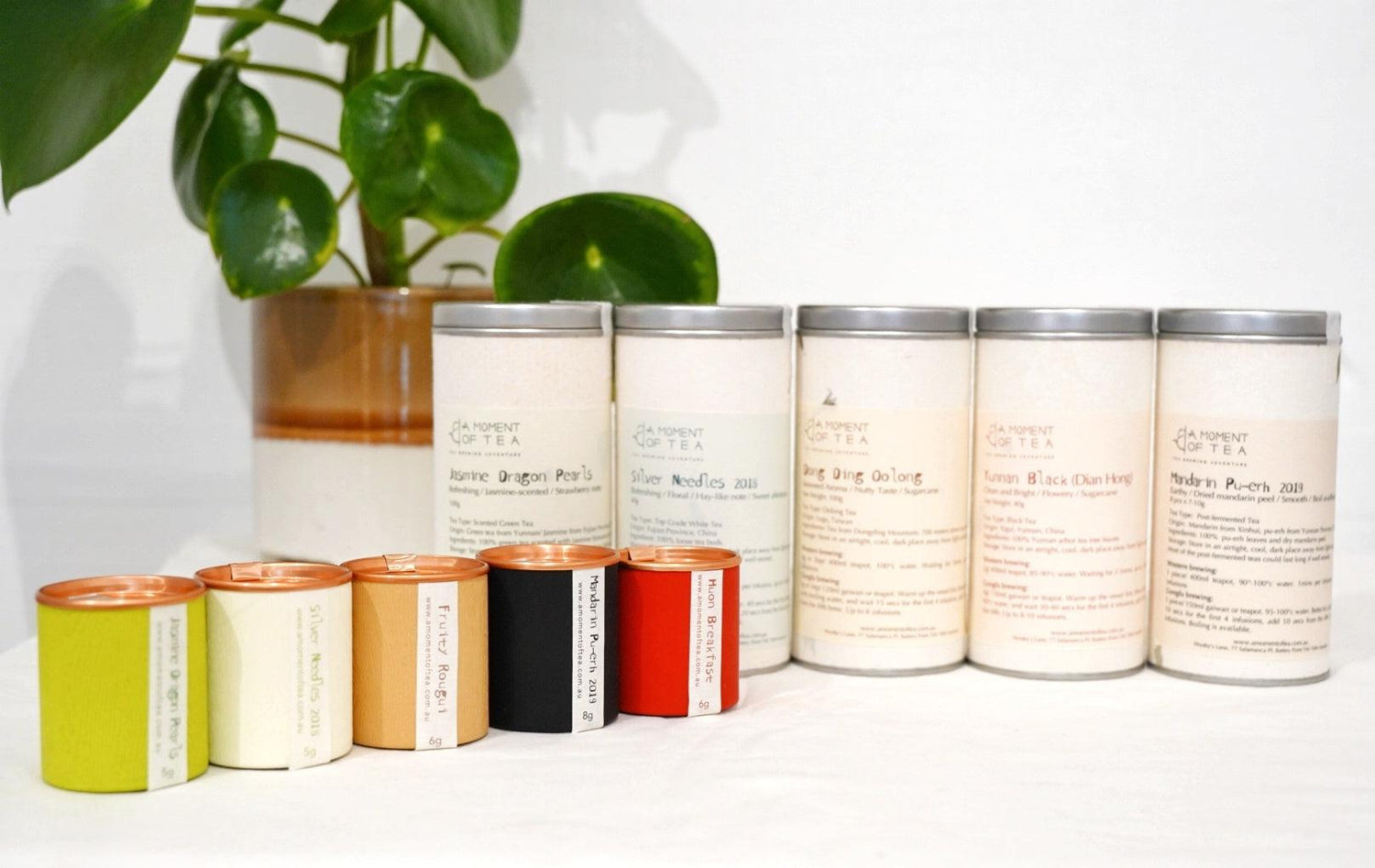

Tea and food pairing: a Chinese perspective
A couple walks into our Tea Bar at Salamanca Art Centre on a Saturday afternoon. They've just had lunch at one of the restaurants nearby, and the woman picks up a tin of Jasmine Dragon Pearls from the shelf. "We love drinking tea with meals," she says, "but we never know which tea actually goes with what food. Is there a rule?"
Tea and food pairing is the practice of choosing a tea whose flavour, body, and temperature properties complement or contrast with a dish. In Chinese tradition, this idea is called 茶配 (chápèi) — selecting tea to go alongside food, much the same way wine regions developed their own pairing customs. The difference is that Chinese tea pairing draws on centuries of everyday eating habits and Traditional Chinese Medicine (TCM) principles, not just flavour matching. One of our customers, Emily, described her Jasmine Dragon Pearls as having "the aroma of a bouquet of flowers, with a hint of strawberry" — that kind of fragrant, clean character is exactly why jasmine tea has been the traditional companion to Cantonese dim sum for generations.
The approach is simpler than you might expect. At its core, Chinese tea-food pairing follows two ideas: balance the thermal nature of tea and food (TCM thinking), and match or contrast the weight of the tea with the weight of the dish.

The principles behind Chinese tea-food pairing
In TCM, foods and teas each have a thermal nature — cool (寒凉, hánliáng), neutral (平, píng), or warm (温热, wēnrè). The general rule: pair cool-natured teas with warm-natured foods, and warm-natured teas with cool-natured foods. This keeps the body in balance. Green tea (绿茶, lǜchá) and white tea (白茶, báichá) are considered cool, so they pair well with richer, warming dishes. Black tea — called red tea (红茶, hóngchá) in China because of its reddish brew colour — and pu-erh (普洱茶, pǔ'ěr chá) are warm-natured, making them good companions for lighter or cooling foods like salads and raw vegetables.
Beyond TCM balance, there's the practical side. Tea works as a palate cleanser between bites. In Chinese dining, you'll often see people sipping tea throughout a meal — not to wash food down, but to reset the palate before the next dish. Pu-erh is famous for this. After a plate of roast duck or braised pork belly, a few sips of ripe pu-erh cut right through the richness. The Chinese phrase 解腻 (jiě nì, literally "dissolve the grease") describes this function, and it's one reason pu-erh has been a staple at Cantonese banquets for centuries.
Then there's flavour direction. You can either complement (similar meets similar) or contrast (opposites highlight each other). A roasted Oolong (乌龙茶, wūlóng chá — literally "dark dragon") with roasted meat is a complement pairing — both share smoky, toasty notes. A light, sweet white tea with a salty cheese is a contrast pairing — each makes the other more noticeable.
Here's a pairing table I've put together from what we serve at the Tea Bar and what I grew up eating in China. Use it as a starting point, not a strict rulebook.
| Tea type | Best food pairings | Why it works | Our recommendation |
|---|---|---|---|
|
Green tea (绿茶, lǜchá) TCM: cool |
Steamed fish, sushi, salads, light vegetables, rice dishes, mild cheeses | The vegetal, fresh character of green tea doesn't overpower delicate flavours. Its cool nature balances the warmth of cooked dishes. | Osmanthus Green Tea — the floral sweetness lifts a simple steamed fish dish |
|
White tea (白茶, báichá) TCM: cool |
Fresh fruit, light pastries, soft cheeses, cucumber sandwiches, scones | White tea's subtle sweetness and silky texture won't compete with gentle flavours. Works by complement — soft meets soft. | Silver Needles White Tea — its honey notes pair with plain scones or shortbread |
|
Light oolong (清香型乌龙) TCM: neutral |
Seafood, steamed dumplings, white-fleshed fish, spring rolls, tofu | Floral oolongs have enough body to stand alongside savoury foods without overwhelming them. Neutral thermal nature suits most dishes. | Alishan High Mountain Oolong — its creamy orchid fragrance goes well with steamed dumplings |
|
Dark/roasted oolong (浓香型乌龙) TCM: warm (after roasting) |
Roasted meats, grilled vegetables, aged cheeses, dark chocolate, nuts | Roasted oolong shares toasty, caramelised notes with grilled and roasted foods. This is complement pairing at its simplest. | Big Red Robe Oolong (大红袍, Dàhóng Páo) — its mineral character and roasted depth match grilled lamb or dark chocolate |
|
Black tea / red tea (红茶, hóngchá) TCM: warm |
Red meat, spiced curries, hearty stews, toast with butter, eggs and bacon | The malty sweetness and full body of black tea holds its own against bold, savoury flavours. In China, it's traditionally drunk in winter with heavier meals. | Yunnan Black Tea (滇红, Diān Hóng) — black sugar and lychee notes with a full-bodied breakfast |
|
Pu-erh (普洱茶, pǔ'ěr chá) TCM: warm |
Fatty meats (roast duck, pork belly), fried foods, rich curries, heavy desserts | Pu-erh's earthy depth and smooth texture cut through oily, rich dishes. This is the classic 解腻 (jiě nì — "dissolve the grease") function Chinese diners rely on. | Ripe Pu-erh 2021 — earthy and clean, the go-to after a heavy meal |
|
Jasmine tea (茉莉花茶, mòlì huāchá) TCM: cool |
Dim sum, dumplings, spring rolls, light noodle soups, sweet pastries | Jasmine tea is the traditional dim sum tea in Cantonese culture. Its floral lift brightens the oily, savoury flavours of steamed and fried dumplings. | Jasmine Dragon Pearls — hand-rolled pearls that unfurl with each steep, keeping pace with a long dim sum session |
|
Smoked tea (烟熏茶, yānxūn chá) TCM: warm |
Smoked salmon, barbecue, cured meats, strong cheeses, campfire-cooked food | Smoky meets smoky. Lapsang Souchong's pine-smoke character echoes the flavour of smoked and cured foods. A bold contrast pairing with creamy blue cheese also works. | Lapsang Souchong Original Smoked (正山小种, Zhèngshān Xiǎozhǒng) — try it with Tasmanian smoked salmon |

Pairing suggestions by occasion
Morning breakfast
Breakfast foods tend to be rich — eggs, toast, butter, bacon. A warming black tea like Yunnan Dian Hong has enough body to stand alongside a full cooked breakfast without getting lost. If your morning is lighter (fruit, yoghurt, granola), a green tea or light oolong brings a clean start. Harrison, one of our customers, noted that "Tasmanian pepper berry adds such an intriguing twist to the traditional black tea flavour" when describing our Tasmanian Breakfast blend — that kind of spiced, full-bodied tea is made for mornings.
Afternoon tea
This is where pairing gets fun. Scones, finger sandwiches, small cakes — classic afternoon tea foods sit in the middle of the flavour spectrum. White tea and light oolong are your friends here (if white tea is new to you, our white tea guide covers the grades). Silver Needles with a plain scone, or Alishan Oolong with cucumber sandwiches. For something richer like chocolate cake, step up to a roasted oolong or even a Tasmanian Lavender Puerh. That blend was awarded at the 2025 Royal Tasmanian Fine Food Awards, and one customer told us: "Sampled this whilst travelling in Tasmania, and now it has become a night time staple! The lavender is a beautiful combination with the sweetness of the pu'erh."

After dinner
This is where pu-erh earns its reputation. After a heavy meal, a cup of ripe pu-erh settles the stomach and cleanses the palate. In southern China, it's standard to end a banquet this way. If you've had a lighter dinner, aged white tea works well too. Alex, who buys our Aged White Tea 2012, told us: "I often have it after dinner, and it never interferes with my sleep." Aged white teas develop a mellow, date-like sweetness over time that makes them a gentle end to the day.
With dessert
Sweet foods call for a tea that can either match the sweetness or provide a clean counterpoint. A jasmine tea with a fruit tart creates a floral echo. A smoky Lapsang Souchong with dark chocolate gives you a bold contrast. And if you're serving something very sweet, a young raw pu-erh or a slightly astringent green tea can cut through the sugar and keep your palate interested.
A tip from our Tea Bar: When pairing at home, brew the tea a bit stronger than you normally would. Food dulls your palate slightly, so a stronger brew maintains its presence alongside the flavours on your plate. For Gongfu-style brewing, add an extra gram of leaf or steep for five to ten seconds longer than usual.
What tea goes with chocolate?
Dark chocolate pairs well with roasted oolong (like Big Red Robe) or smoked Lapsang Souchong — both share deep, roasted notes. Milk chocolate works better with a malty black tea like Yunnan Dian Hong. White chocolate, being mostly fat and sugar, needs something with a clean cut — try a jasmine tea or a light green tea.
Can I drink tea during a meal or only before and after?
In Chinese dining culture, tea is drunk throughout the meal. It's not just a before-or-after thing. Tea cleanses the palate between dishes and helps with digestion. The key is choosing the right tea for the meal's heaviness — light teas for light meals, bold teas for rich ones.
Is there a tea that goes with everything?
If I had to pick one, it would be a medium-oxidised oolong like Dong Ding. Its neutral thermal nature and balanced flavour profile — not too light, not too heavy — makes it a safe match for most foods. At our Tea Bar, it's the tea I reach for when I'm not sure what a customer has eaten.
Do I need to change how I brew tea when pairing with food?
Slightly. Brew a bit stronger — add about one extra gram of leaf per session, or extend each steep by five to ten seconds. Food coats the palate, so you need a tea with enough intensity to come through. If you're doing Gongfu-style brewing, shorter but more frequent steeps work well during a meal because you can sip between bites.
What tea do Chinese restaurants serve with dim sum?
Traditionally, Cantonese dim sum restaurants (called 茶楼, cháloú, literally "tea house") serve three teas: jasmine (茉莉花茶), pu-erh (普洱), and chrysanthemum (菊花茶, júhuā chá). Jasmine is the most common choice. The floral fragrance lifts the flavours of steamed dumplings, char siu bao, and fried spring rolls. Pu-erh cuts through the richness of fried items. Chrysanthemum is caffeine-free and cooling, often chosen in summer.
Teas mentioned in this article
- Osmanthus Green Tea
- Silver Needles White Tea
- Alishan High Mountain Oolong
- Dong Ding Oolong
- Big Red Robe Oolong
- Yunnan Black Tea (Dian Hong)
- Tasmanian Breakfast Blended Black Tea
- Ripe Pu-erh 2021
- Tasmanian Lavender Puerh
- Jasmine Dragon Pearls
- Lapsang Souchong Original Smoked
- Aged White Tea 2012
Published: March 2026 | Last updated: July 2026