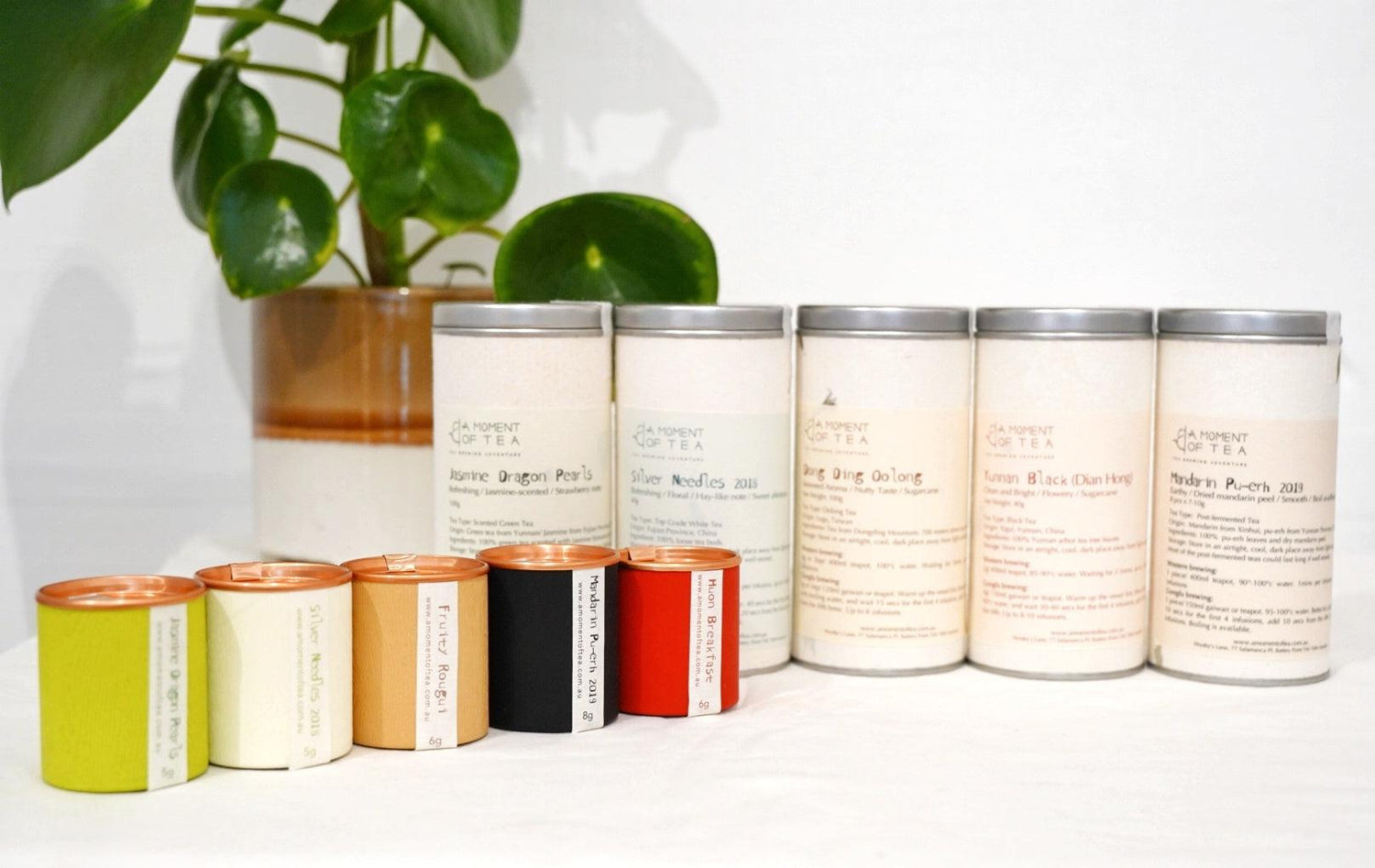

What is Chinese tea? A complete beginner's guide
Chinese tea is tea made from the leaves of the Camellia sinensis plant, processed using methods developed in China over thousands of years. All six major types of Chinese tea — green, white, yellow, oolong, black, and dark — come from the same species of plant. The difference between them is how the leaves are handled after picking: how much they're allowed to oxidise, pan-fired or steamed, rolled tightly or left loose, aged or drunk fresh.

A woman stands at the counter of our Tea Bar at Salamanca Art Centre in Hobart, turning a small clay teapot in her hands. "So wait," she says, looking up. "This green tea and this black tea come from the same plant?" I nod. It's the question I hear most often — at the Tea Bar, at Salamanca Market, sometimes several times a week. I usually explain it this way: think of apples. A Granny Smith and a Fuji are both apples, but they taste nothing alike because the variety is different and they're grown in different places. Tea works the same way — same species, but different varieties, different regions, and most importantly, different processing after picking. The leaf on the left was pan-fired within hours of being picked to stop oxidation. The leaf on the right was allowed to oxidise fully, then dried in an oven. Same plant, completely different cup of tea.
Thomas, who wandered into our shop on a quiet Tuesday, put it well: "Even if you aren't a huge tea fan, like myself, it's still interesting, peaceful and enjoyable experience. A nice place to just pause." That reaction is common. People walk in expecting tea bags and walk out understanding that Chinese tea (中国茶, zhōngguó chá) is a whole category they hadn't considered.

The six types, briefly
I won't go deep into each type here — we have a separate guide for that. But here's the short version so you know what you're looking at when you browse a tea shelf or visit our Chinese tea collection.
Green tea (绿茶, lǜchá) is the least processed. The leaves are heated quickly — usually pan-fired in a hot wok — to stop oxidation. The result tastes fresh and vegetal, sometimes with a chestnut sweetness. Dragon Well (龙井, lóngjǐng) is China's most well-known green tea, with flat, spear-shaped leaves and a clean, nutty finish.
Amelia had been avoiding green tea for years, convinced it would be bitter. "I've always steered clear of green teas due to their bitterness," she told us, "but a chance tasting at Salamanca Market changed my mind. This tea has zero bitterness." That bitterness she remembered likely came from water that was too hot or steeping that went too long. When you brew green tea at 70–80°C instead of boiling, the difference is noticeable.
White tea (白茶, báichá) goes through even less handling than green tea — just withering and drying, no pan-firing or rolling. The leaves and buds are dried slowly, which gives white tea a soft, naturally sweet flavour. Our Aged White Tea 2012 (老白茶) has been stored for over a decade and has developed a rich, date-like sweetness that fresh white tea doesn't have.
Yellow tea (黄茶, huángchá) is the rarest. It's made like green tea but with an extra step: the leaves are wrapped in cloth and left in a warm, humid environment for up to three days. This "yellowing" process gives it a smoother, nuttier character than green tea, with less of the grassy edge.
Oolong (乌龙茶, wūlóng chá — literally "dark dragon") sits between green and black tea. The leaves are partially oxidised, anywhere from 15% to 85%, which is why oolongs vary so much. A light oolong like Alishan High Mountain Oolong tastes floral and buttery. A roasted oolong like Big Red Robe (大红袍, dàhóngpáo) has deep mineral and toasted grain notes.
Black tea — called red tea (红茶, hóngchá) in China because of its reddish brew colour — is fully oxidised. The leaves are rolled hard to break the cell walls, then left to oxidise in a warm, humid room until they turn dark. Chinese black teas are drunk without milk or sugar, which lets you taste the natural sweetness. Lapsang Souchong (正山小种, zhèngshān xiǎozhǒng), a pine-smoked black tea from the Wuyi Mountains, is one of the most distinctive teas you'll find anywhere.
Dark tea (黑茶, hēichá) is fermented by microorganisms — a different process from oxidation. Pu-erh (普洱, pǔ'ěr), the most famous dark tea, comes from Yunnan province and can be aged for decades. Our Tasmanian Lavender Puerh, awarded at the 2025 Royal Tasmanian Fine Food Awards, blends ripe pu-erh with Tasmanian lavender for an earthy, calming cup.
Loose leaf vs tea bags: why it matters
Most tea bags contain what the industry calls "fannings" or "dust" — the broken fragments left over after whole leaves are sorted and graded. These fragments brew fast, but they lose the aromatic compounds and layered flavours that whole leaves keep. A standard tea bag generally holds about 1.5 grams of this material. A serve of loose leaf tea uses 3–5 grams of whole or lightly rolled leaves.
The practical difference: a good loose leaf tea can be steeped three to eight times, each infusion tasting slightly different as the leaves open up. A tea bag gives you one cup, and it tastes the same from start to finish. Over a week, that loose leaf pouch is often cheaper per cup than the box of bags — and the flavour isn't comparable.
Tina, a regular visitor to our Tea Bar, noticed this straight away. "The tea selection is full of China and Taiwan varieties rarely found in Australia, along with Tasmanian-only tea blends," she wrote. The variety you find in loose leaf Chinese tea simply doesn't exist in the tea bag aisle.

You don't need special equipment to start. A mug, a small strainer, and some hot water will do. Pour the water at the right temperature (check the packet — it varies by tea type), wait a couple of minutes, and strain. That's it. If you later want to try Gongfu-style brewing with a gaiwan (盖碗, gàiwǎn) or a small clay teapot, the experience deepens, but it's not required.
Where to start if you're new
If you're in Hobart, the simplest thing is to visit. Our Tea Bar is at Salamanca Art Centre, 77 Salamanca Place — open Tuesday to Friday 11am–5pm, Saturday 10am–3pm, and Sunday 11am–4pm. You can also find us at Salamanca Market every Saturday morning. We'll brew a few teas for you, talk through what you're tasting, and help you figure out what you like. There's no pressure to buy anything.
Arabella tried Jasmine Dragon Pearls (茉莉龙珠, mòlì lóngzhū) at the market earlier this year, "slowly worked through the tin," and ordered a replacement online once she ran out. That's a common path — try at the market, then order through our website when you're ready.
If you're not in Tasmania, our sampler packs are a low-commitment way to try several teas at once. The Morning Teas Sampler Pack gives you three teas chosen for lighter, brighter flavours — good for people coming from coffee or English breakfast.
One thing I'd suggest for complete beginners: start with a green tea or a light oolong. These are forgiving, approachable, and show you straight away how different Chinese tea is from what you may have tried before. If you're curious about the deeper end, a pu-erh or a roasted oolong will take you somewhere unexpected.
If you want suggestions matched to your own cupboard, our guide to which Chinese tea to try first starts from what you already drink and points you to a matching tea.
Chinese tea is a big subject. This guide is the starting point — follow the links throughout to go deeper on any type that catches your interest. And if you're wondering how all this began, our short history of tea follows the leaf from Tang dynasty tea cakes to the loose leaf brewing we use today.

Tips from our Tea Bar
Joanne, who trained at Lian Yu Tea School in Beijing and has been studying tea since 2014, shares three things she tells every first-time visitor:
- Water temperature matters more than steeping time. Green and white teas need cooler water (70–85°C). Oolong, black, and dark teas do well with near-boiling water (90–100°C). If your tea tastes bitter, try lowering the temperature before you give up on it.
- Smell the lid. After pouring from a gaiwan or teapot, bring the lid to your nose. The aroma trapped on the underside tells you things about the tea that the liquid alone doesn't.
- Re-steep. A quality loose leaf tea is meant to be brewed more than once. The third or fourth infusion is often the best — the leaves have fully opened and the flavour is at its most complete.
Frequently asked questions
Is Chinese tea the same as regular tea?
All tea comes from the Camellia sinensis plant — Chinese, Indian, and Japanese alike. What makes Chinese tea distinct is the processing tradition — six categories of tea, each made differently from the same leaf. Herbal "teas" like chamomile and rooibos are not true tea; they're tisanes made from other plants.
Does Chinese tea contain caffeine?
Yes. All true tea contains caffeine. The amount depends more on the specific tea plant variety and how it was grown than on the type (green, black, etc.). If you're looking for lower caffeine options, white teas and aged pu-erh tend to be gentler in the evening.
Do I need special teaware to drink Chinese tea?
No. A mug and a strainer work fine. Gongfu-style brewing with a gaiwan or small teapot uses more tea leaves and shorter steeping times, which brings out different flavours — but it's something to try when you're ready, not a requirement.
Why is loose leaf tea more expensive than tea bags?
Loose leaf tea uses whole or lightly rolled leaves, which are higher grade than the fragments in most tea bags. But because loose leaf tea can be re-steeped multiple times, the cost per cup is often lower. A 50g pouch of Dragon Well brewed Western-style gives you around 25 steeps, each good for two or three cups. Brewed gongfu-style in a small gaiwan, you'll get 10 to 12 infusions per session — the exact number depends on the vessel size and how much leaf you use.
Teas mentioned in this article
- Dragon Well (Long Jing) — pan-fired green tea from Hangzhou
- Jasmine Dragon Pearls — hand-rolled green tea scented with jasmine
- Aged White Tea 2012 — decade-aged white tea with date-like sweetness
- Alishan High Mountain Oolong — light, floral Taiwanese oolong
- Big Red Robe (Da Hong Pao) — roasted oolong from Wuyi Mountains
- Lapsang Souchong — pine-smoked black tea from Wuyi Mountains
- Tasmanian Lavender Puerh — ripe pu-erh with Tasmanian lavender
- Morning Teas Sampler Pack — three lighter teas for beginners
Published: March 2026 | Last updated: July 2026