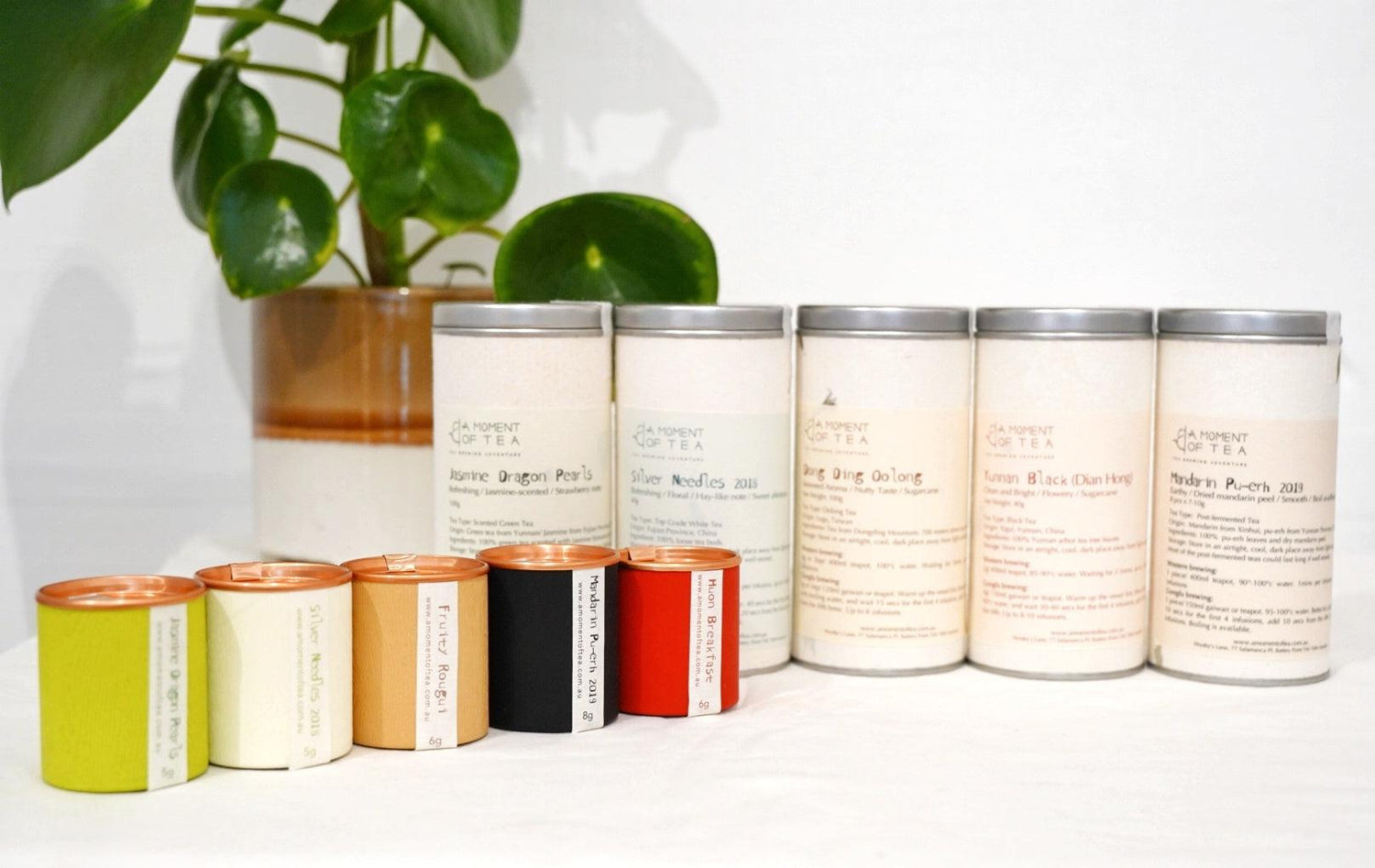

How to store tea properly
Storing tea properly means protecting the leaves from moisture, light, heat, and strong odours — the four things that break down flavour fastest. How you store your tea matters almost as much as how you brew it, and different types of tea need different approaches.
Most people don't think about storage when they buy tea. At our Tea Bar, when someone picks up a pu-erh (普洱, pǔ'ěr) cake or brick, we give them a separate cotton bag and explain how to use it. We also ask where they live. A customer heading back to Queensland, where it's humid most of the year, gets different advice from someone here in Hobart, where the air stays dry. That one question — "where do you keep your tea at home?" — changes everything.

The four enemies of tea
Tea leaves are dry and porous. They absorb whatever is around them. Here's what damages them:
Moisture is the biggest risk. When tea absorbs humidity from the air, it loses crispness and can develop mould. This is why storage advice differs so much between dry climates like Hobart and tropical ones like Cairns or Darwin.
Light breaks down the compounds that give tea its colour and flavour. Green tea is the most sensitive — even a few weeks on a sunlit shelf can turn it dull and flat. Keep all tea in opaque containers or inside a cupboard.
Heat speeds up the chemical changes that make tea go stale. A cupboard away from the stove or oven is better than one right next to it. Room temperature is fine for most teas.
Strong odours get absorbed by tea leaves quickly. Storing tea near spices, coffee, or cleaning products will change its flavour. I've had customers tell me their oolong tasted like curry — it was sitting in the same cupboard as their spice rack.
The most common mistake I see: leaving tea in a bag that isn't properly sealed, on a kitchen bench in direct sunlight. That combination of air, light, and heat will flatten even a good tea in a few weeks.
Different teas, different rules
Not all tea should be stored the same way. The level of oxidation — how much the leaves were processed — determines how sensitive they are.
Green tea and fresh white tea
Green tea (绿茶, lǜchá) is the most fragile. The leaves were heated early in processing to stop oxidation, which preserves their fresh, grassy character — but also makes them more vulnerable to going stale. Keep green tea in an airtight container, away from light, and try to use it within three to six months of opening.
If you won't finish it within a few weeks, the fridge can help. Seal the tea tightly in a bag with as little air as possible, then place it inside an airtight container so it doesn't pick up fridge odours. When you take it out, let the container come back to room temperature before opening it — cold tea leaves attract condensation from warm air, and that moisture is exactly what you're trying to avoid. Refrigeration at 4–8°C helps preserve green tea's sensory quality, and this practice is standard in both Chinese and Japanese tea culture.
Fresh white tea follows similar rules. Silver Needles and young Gong Mei (贡眉) are delicate and best used within the first year.
Oolong and black tea
Oolong (乌龙茶, wūlóng chá — literally "dark dragon") and black tea — called red tea (红茶, hóngchá) in China because of its reddish brew colour — are more forgiving. The oxidation and roasting they go through during production makes them more stable. An airtight tin or canister at room temperature, out of direct light, is all you need.
Roasted oolongs like Da Hong Pao (大红袍, dà hóng páo) are particularly sturdy. They'll keep well for a year or more if sealed properly. Lightly oxidised oolongs like Alishan are a bit more sensitive — treat them closer to green tea.

Pu-erh: the one that needs to breathe
Pu-erh is the exception to almost every storage rule above. Raw pu-erh (生普, shēng pǔ) is a living tea — microbes continue to slowly ferment the leaves over years and decades. This process is called 陈放 (chénfàng, aging). Sealing it in an airtight container stops that process dead.
Store raw pu-erh in a breathable wrapper — cotton cloth, bamboo, or the paper it usually comes in. Keep it in a dry, ventilated spot away from strong smells. Most tea professionals aim to keep storage temperature at or below 25°C, with relative humidity in the 60–70% range.
In Hobart's dry climate, this happens naturally in most cupboards. Our regular customer MingLu told us: "A Moment of Tea has been my go-to tea brand since my TAS days. Even after moving to QLD, it's still my top pick." When she first moved north, we talked about how the humidity change would affect her tea storage — pu-erh cakes that sat happily in a Hobart cupboard now needed more attention in Queensland's tropical air.
Ripe pu-erh (熟普, shú pǔ) is less demanding. The accelerated fermentation it goes through during production means it's already quite stable. An airtight container works fine. Ripe pu-erh will keep for about ten years, but it doesn't continue to improve the way raw pu-erh does.
Aged white tea: the quiet ager
Some white teas, particularly Shoumei (寿眉) and Gong Mei, can age like pu-erh. Our Aged White Tea 2012 has spent over a decade developing deeper, sweeter flavours — what tea people describe as a date-like sweetness. Long-term aging also changes a tea's character in Traditional Chinese Medicine terms: aged teas tend to become milder and more warming than their fresh versions.
If you're aging white tea, follow the same approach as raw pu-erh: breathable storage, dry environment, no strong odours.

Practical tips from our Tea Bar
Here's what we actually do and recommend:
- Use opaque, airtight containers for most teas. A ceramic or tin canister works well. Glass jars look nice but let in light — if you use glass, keep it inside a cupboard.
- Don't store different teas in the same container unless you want them to taste the same. Tea absorbs flavour from whatever is nearby, including other teas.
- Buy in smaller quantities if you drink slowly. A 50g bag of green tea will stay fresher than a 200g bag that sits open for months. Arabella, one of our customers, put it well: "Tried this tea at the Salamanca Market earlier this year, absolutely fell in love, slowly worked through the tin and have finally ordered a replacement." That rhythm — finishing one tin before opening the next — is one of the simplest ways to keep your tea tasting its best.
- For pu-erh, use the bag we give you. When you buy a pu-erh cake or brick from us, we provide a cotton storage bag. Wrap the cake in its original paper, place it inside the bag, and keep it somewhere dry with some air circulation. Don't put it in a plastic bag or sealed container.
- Consider your climate. In Hobart, our dry air makes storage easy for most teas. In northern Australia, you may need extra steps for humidity control, like silica gel packets or a dedicated storage cupboard.

Quick reference: storage by tea type
| Tea type | Container | Temperature | Shelf life (opened) | Fridge? |
|---|---|---|---|---|
| Green tea | Airtight, opaque | Cool or room temp | 3–6 months | Yes, if storing long-term |
| Fresh white tea | Airtight, opaque | Room temp | 6–12 months | Optional |
| Oolong (roasted) | Airtight | Room temp | 12+ months | No |
| Oolong (light) | Airtight, opaque | Cool or room temp | 6–12 months | Optional |
| Black tea (红茶) | Airtight | Room temp | 12–24 months | No |
| Raw pu-erh | Breathable (cotton or paper) | 20–25°C | Improves with age | No |
| Ripe pu-erh | Airtight or breathable | Room temp | Up to ~10 years | No |
| Aged white tea | Breathable | Room temp | Improves with age | No |
Can I store tea in the fridge?
For green tea and lightly oxidised oolongs, yes — if you seal it well and let it return to room temperature before opening. For pu-erh and aged teas, no. The cold stops the aging process, and fridge odours transfer to the leaves easily.
How do I know if my tea has gone stale?
Smell it. Fresh tea has a clear, distinct aroma. Stale tea smells flat or papery. If you brew it and the flavour is thin compared to when you first opened it, the tea has lost its freshness. It's still safe to drink — just less enjoyable.
Does tea expire?
Tea doesn't spoil the way food does, but most teas do lose flavour over time. Green and fresh white teas lose the most. Oolong and black tea hold up longer. Raw pu-erh and aged white tea are the exceptions — they're meant to improve with time, sometimes for decades. In Chinese tea culture, aging is measured in stages: one year is short-term, three to five years is mid-term, and ten years or more is long-term.
Should I keep tea in its original packaging?
The resealable bags our teas come in work well for short-term storage. For longer storage, transfer the tea to an airtight canister. Pu-erh should stay in its original paper wrapper inside a breathable bag — not plastic, not a sealed jar.
Teas mentioned in this article
- Raw Pu-erh Ancient Single Tree
- Ripe Pu-erh Cake
- Ripe Pu-erh Brick
- Ripe Pu-erh Loose Leaf
- Tasmanian Lavender Pu-erh
- Aged White Tea 2012
- Gong Mei White Tea
- Silver Needles White Tea
- Big Red Robe Oolong (Da Hong Pao)
- Alishan High Mountain Oolong
- Flower Tea Canister
Browse our pu-erh collection · Browse our green tea collection · Browse our white tea collection
For more on traditional Chinese brewing methods, see our guide to gongfu tea brewing.
Published: March 2026 | Last updated: July 2026