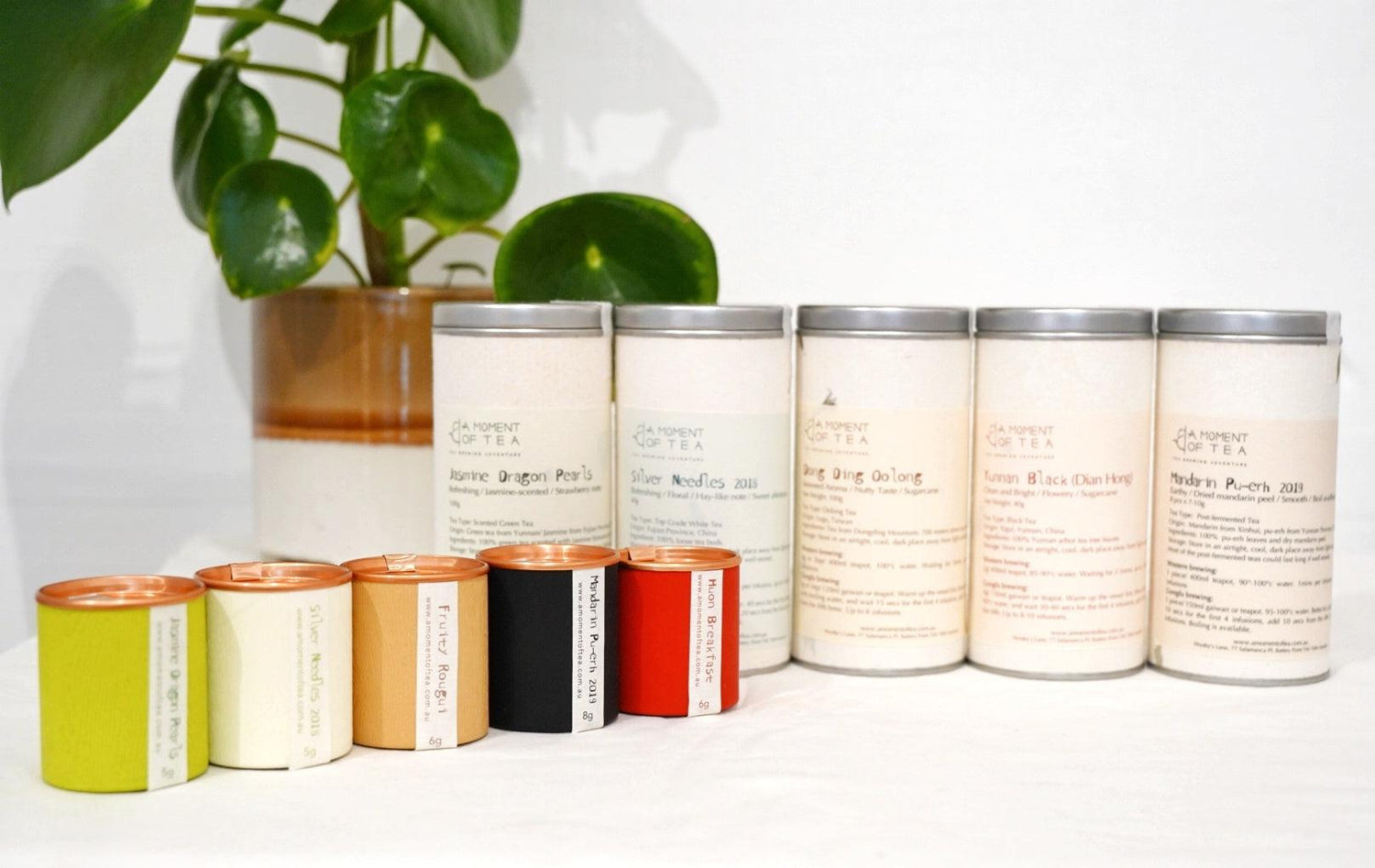

Gongfu tea brewing: a step-by-step guide
Gongfu brewing (功夫泡, gōngfū pào) is a Chinese method of making tea using a small vessel, a high ratio of tea leaves to water, and multiple short infusions. The word gongfu (功夫) means "skill developed through practice" — the same word behind kung fu. In tea, it refers to the care and attention you put into each step of brewing. Rather than one long steep in a large pot, gongfu brewing produces many small pours, each tasting slightly different as the leaves open and release their flavour over six to ten rounds.
Why would anyone brew tea this way? It's the question I hear most often at Salamanca Market on Saturday mornings. Someone walks past our stall, notices the cups, and stops. "Why are those cups so tiny?"

The cups are small because you're not making one big mug of tea. You're making many small rounds, and each one tastes different. The first infusion might be light and floral. By the third or fourth, the flavour deepens — richer, sweeter, more complex. Renga, a visitor who tried the gongfu experience at our Tea Bar, described it this way: "They start the ceremony then you continue, which is fairly easy to do. Make sure you have at least 45 minutes." That timing is about right. Gongfu brewing is not rushed. It's not complicated either, but it asks you to slow down.
At our Tea Bar in Salamanca Art Centre, the menu offers two ways to drink tea. The first is A Pot of Tea — Western-style, brewed in a 250ml pot, simple and ready to pour. The second is Something Ritual: a gongfu brewing session where Joanne or our staff prepare the tea using the traditional method, then hand the teaware over so you can continue steeping on your own. People choose the gongfu option for different reasons. Some are curious. Some have visited tea houses in Hong Kong, Taiwan, or mainland China and want that experience again. Others have been to a Chinese friend's home and watched the whole process without quite understanding what was happening. This guide walks through it step by step.
What do you need for gongfu brewing?
Gongfu brewing uses a few pieces of teaware that are not common in Western kitchens. None of them are expensive, and you can start with just two or three.
A gaiwan or a small teapot. A gaiwan (盖碗, gàiwǎn) is a lidded bowl — a bowl, a lid, and a saucer, three pieces. It's the most versatile brewing vessel because it works with any tea type, and it doesn't retain flavour between sessions the way clay does. We wrote a full guide to brewing with a gaiwan, including the grip that keeps your fingers cool. If you prefer a teapot, a Yixing clay teapot (紫砂壶, zǐshā hú) is the traditional choice. Yixing clay is porous, which means the pot slowly absorbs the character of the tea you brew in it. Most people dedicate one Yixing pot to a single type of tea — our Yixing seasoning guide explains why, and how to prepare a new pot. A gaiwan has no such requirement — you can brew green tea in the morning and oolong (乌龙茶, wūlóng chá — literally "dark dragon") in the afternoon without any crossover.

A fairness cup. Called a gongdao cup (公道杯, gōngdào bēi) in Chinese — "fairness cup" because it ensures every person's cup gets the same strength of tea. After you pour the tea out of the gaiwan, it goes into this pitcher first. Then you pour from the pitcher into the individual tasting cups. Without it, the first cup poured would be weaker and the last cup would be over-steeped.

Tasting cups. These are the small cups (品茗杯, pǐnmíng bēi). They hold about 30–50ml each. The small size is intentional — you're drinking many rounds, not one large serving.
Optional extras: a tea tray to catch spills, tea tongs for handling hot cups, and a tea scoop for measuring leaves. But a gaiwan, a fairness cup, and a couple of small cups will get you started.

The six steps of gongfu brewing
These steps work for oolong, black tea — called red tea (红茶, hóngchá) in China because of its reddish brew colour — pu-erh, and most other teas suited to gongfu. Green and white teas can also be brewed this way, though they need lower temperatures and gentler handling.
Step 1: Warm the vessel — wēnhú (温壶)
Boil your water. Pour it into the gaiwan or teapot, swirl it around, then pour it out into the fairness cup. Pour from the fairness cup into each tasting cup, then discard the water. This serves two purposes: it heats every piece of teaware so the brewing temperature stays consistent, and it cleans the cups.
Step 2: Place the tea — zhìchá (置茶)
Add the dry tea leaves to the warm gaiwan. For oolong, use enough to fill about one quarter of the vessel if the leaves are tightly rolled into balls — they'll expand to fill most of the space once they open. For looser, bulkier teas like lightly rolled oolong, you may fill up to seven-eighths of the vessel. A general starting point: about 6–8 grams per 150ml gaiwan.
Once the leaves are in the warm vessel, put the lid on and give it a gentle shake. Then lift the lid and smell. The warmth of the vessel releases the dry leaf aroma — this is your first introduction to the tea before any water touches it.

Step 3: Rinse the tea — xǐchá (洗茶) or awaken the tea — xǐngchá (醒茶)
Pour hot water over the leaves, then pour it out almost immediately — within two or three seconds. This first pour is not for drinking. It rinses the leaves and starts to "wake them up," allowing tightly rolled leaves to begin unfurling. Pour this rinse water over your tasting cups one more time to keep them warm.
For aged teas like pu-erh (普洱, pǔ'ěr), some people do two rinses. For fresh green tea, skip the rinse entirely.
Step 4: Steep and pour — chōngpào (冲泡) and chūtāng (出汤)
Now the real brewing begins. Pour hot water into the gaiwan, filling it to just below the rim. Start timing.
For the first infusion, steep for about 45 seconds to one minute — long enough for the leaves to begin releasing their flavour, but short enough that the tea doesn't become bitter. Pour the tea out completely into the fairness cup by tilting the gaiwan lid slightly to create a gap and holding the saucer underneath. Every drop should come out; leaving water sitting on the leaves will over-extract them.
From the fairness cup, pour into each tasting cup. The fairness cup ensures even strength.
Here are general parameters by tea type:
- Oolong — lightly roasted: 90–95°C water, first steep about 1 minute. For tightly rolled ball-shaped oolong, the second and third steeps can be shorter (the leaves are still expanding). Add time from the fourth steep onward.
- Oolong — roasted (e.g. Big Red Robe): 95–100°C water, first steep 45 seconds to 1 minute. Roasted teas release flavour quickly, so start shorter and add more time with each round.
- Black/red tea: 90–100°C water, first steep about 1 minute. Add 20–30 seconds per subsequent steep.
- Pu-erh (raw or ripe): 95–100°C water, first steep 30 seconds to 1 minute (after rinsing). Add 10–20 seconds per steep. Good pu-erh can go 10–20 rounds.
- White tea: 80–90°C water, first steep 1 minute or longer. White tea releases its compounds slowly because the leaves are unrolled, so each steep needs more time than you might expect.
- Green tea: 70–80°C water, first steep about 1 minute. Add 20–30 seconds per steep. Typically 3–5 steeps.
Step 5: Taste — pǐnyǐn (品饮)
Pick up the small cup. Bring it to your nose first and breathe in the aroma. Then take a small sip, letting the tea spread across your tongue before swallowing. Pay attention to the finish — does it leave a sweet aftertaste (回甘, huígān)? Can you feel it in the back of your throat (喉韵, hóuyùn)? These sensations are what gongfu brewing is designed to reveal. They're harder to notice in a full mug but become clear in a small, concentrated pour.

Benjamin, who visited our Tea Bar, said three words after his session: "Peaceful, meaningful, warm. Tea how it should be!" That sums up what many people feel. The small cups, the repeated pouring, the slow pace — it turns drinking tea into something you actually notice.
Step 6: Re-steep — continue brewing
Pour water in again. Increase the steeping time by 10–30 seconds, depending on the tea. Pour, taste, compare. A good oolong will give you five to eight rounds. Each one will taste different. The fourth or fifth steep is often the best — the leaves have fully opened and the flavour is at its most layered.
After the final steep, you can lift the lid and look at the spent leaves (观叶底, guān yèdǐ). Their colour, shape, and completeness tell you about the quality of the tea — whole leaves that have returned to a uniform green or brown are a good sign.
What are the common mistakes in gongfu brewing?
Most problems with gongfu brewing come down to three things:
Water too cool. Oolong and pu-erh need hot water — 90°C to boiling. If you pour 80°C water on a roasted oolong, you'll get a flat, one-dimensional cup. The heat is what draws out the deeper flavours. The exception is green and white teas, which do need lower temperatures. Match the water to the tea.
Steeping too long. In gongfu, you're making many rounds. If your first infusion runs three minutes, the tea will taste harsh and bitter. Start short — under a minute — and add time as you go. Bitterness comes from heat; astringency comes from time. If your tea is astringent, steep for less time. If it's bitter, reduce the water temperature.
Too little tea. Western-style brewing uses about 2–3 grams of tea per cup. Gongfu uses far more — roughly 6–8 grams per small pot. If you use too few leaves, the tea will taste thin and watery, and you won't get more than a couple of rounds before the flavour fades. The high leaf-to-water ratio is what makes gongfu work.
Tips from our Tea Bar
Joanne, who trained at Lian Yu Tea School in Beijing and has been practising tea since 2014, shares a few things she does differently from the textbook:
- Smell the gaiwan lid after each pour. The underside of the lid traps aroma compounds that you can't smell in the cup. The way the scent changes between steeps tells you how the tea is developing.
- If you're serving two people, pour in an alternating pattern — cup A, cup B, cup B, cup A — rather than filling one cup first. This keeps the concentration even without needing to pour everything into a fairness cup first, though using the fairness cup is still the more reliable method.
- Don't watch a timer for every steep. After a few sessions, you'll develop a feel for it. The colour of the liquor in the fairness cup is a useful guide — for oolong, a clear golden amber usually means the steep is about right.
Kelly, who stopped in on a weekday afternoon, captured the feeling well: "It was a little moment of pause and reflection over a delicious cup of tea." That's gongfu at its core — not a performance, but a way of paying attention.

Gongfu vs Western-style: a quick comparison
- Vessel size: Gongfu uses 100–200ml. Western uses 250–500ml.
- Tea amount: Gongfu uses 6–8g per session. Western uses 2–3g per cup.
- Steep time: Gongfu starts at under 1 minute. Western is typically 3–5 minutes.
- Number of steeps: Gongfu yields 5–10+. Western gives 2–3.
- Best for: Gongfu rewards oolongs, pu-erh, and roasted teas where you want to taste how the flavour evolves. Western works well for green tea, herbal blends, and any time you want a quick, simple cup.
At our Tea Bar, we serve both. A Pot of Tea is Western-style — a 250ml pot, brewed and ready. Something Ritual is gongfu — Joanne prepares the first steeps, then you take over. Most people who try both end up returning for the gongfu option, because once you've tasted how a tea changes across eight infusions, a single steep feels like reading only the first chapter of a book.
Frequently asked questions
Do I need a gaiwan or can I use a regular teapot?
You can use any small teapot — the key is the size (100–200ml) and the ability to pour quickly. A gaiwan is the most common choice because it's inexpensive, easy to clean, and works with every tea type. A Yixing clay teapot is another traditional option, though most people dedicate each pot to one type of tea because the clay absorbs flavour over time.
Which teas work best for gongfu brewing?
Oolong teas respond especially well — both light and roasted styles. Pu-erh, aged white tea, and Chinese black teas (red teas) also shine with this method. Delicate green teas and very light white teas can be brewed gongfu-style, but they need lower temperatures and more careful timing.
How long does a gongfu session take?
About 30–45 minutes for a full session of six to eight steeps. You can do fewer rounds if you're short on time. Even three or four steeps will show you how the flavour changes — which is the whole point.
Is gongfu brewing difficult to learn?
The steps are simple enough to follow. The skill comes with practice — learning to judge steep time by colour rather than a timer, adjusting the leaf amount to your taste, handling a hot gaiwan without burning your fingers. Give yourself three or four sessions and you'll feel comfortable with it.
Can I try gongfu brewing at your Tea Bar?
Yes. At our Tea Bar in Salamanca Art Centre, 77 Salamanca Place, Hobart, you can order Something Ritual from the menu. Joanne or our staff will prepare the first steeps and walk you through the process, then hand the gaiwan or teapot over so you can continue. Open Tuesday to Friday 11am–5pm, Saturday 10am–3pm, Sunday 11am–4pm.
Teas mentioned in this article
- Big Red Robe (Da Hong Pao) — roasted oolong from Wuyi Mountains
- Dong Ding Oolong — classic Taiwanese roasted oolong
- Alishan High Mountain Oolong — light, floral Taiwanese high mountain tea
- Old Fir Narcissus Oolong — aged tree oolong from Wuyi Mountains
- Aged White Tea 2012 — decade-aged white tea, works well brewed gongfu-style
- Tasmanian Lavender Puerh — awarded at the 2025 Royal Tasmanian Fine Food Awards
Published: March 2026 | Last updated: July 2026
If you're in Hobart, drop by our Salamanca Tea Bar — we'll brew whatever interests you, no pressure to buy. You'll also find us at Salamanca Market every Saturday morning.