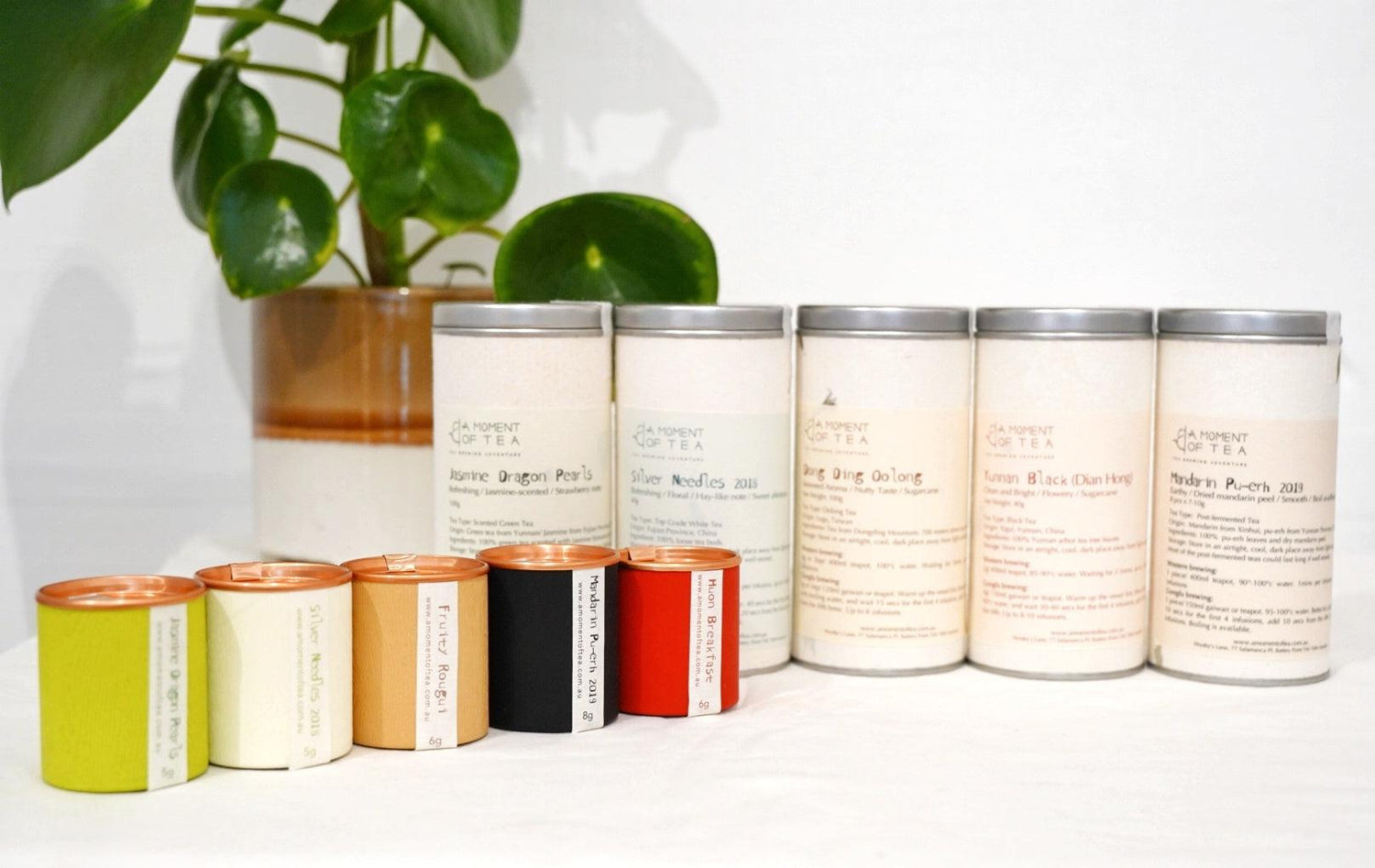

How to brew tea in a thermos: the men pao method
Here is the number that surprises people: for a full 800ml flask of tea, you want about four grams of leaf. That is roughly a quarter of what the same water would take in gongfu brewing. Get the ratio right and a thermos will pour smooth, warm tea from your first sip at 9am to the last one mid-afternoon.
Brewing tea directly in a thermos is called men pao (焖泡, mènpào — "smothered steeping") in Chinese, and it is the easiest way to take good loose leaf tea out of the house: leaves in the flask before a hike, a short trip, or a long market day, hot water on top, and the same brew topped up wherever you end up. No teapot, no strainer, no timing. It asks for exactly one skill — restraint with the leaf.

How to brew tea in a thermos
- Warm the flask. Rinse it with hot water and pour that out. A cold flask steals heat from your first steep.
- Add the leaf — about 1g per 200ml. For a full 800ml flask that is 4-5g, no more. This is the step where instinct misleads people.
- Rinse the leaves. For ripe pu-erh and aged white tea, pour in a splash of hot water, swirl, and tip it out through the filter. This wakes the leaves and clears any dust.
- Fill with hot water and close the lid. Boiling water for dark teas; cooler for green (more on that below).
- Wait 30 to 60 minutes. The tea is drinkable earlier, but this is where it settles into itself.
- Sip through the day. When the flask runs low, top it up with hot water — good leaves keep giving.
Why so little leaf? In a teapot, you control strength with time: lots of leaf, short steeps. In a thermos the leaves sit in the water for hours, so the extraction runs to completion no matter what you do. The only lever left is quantity. A small amount of leaf, fully extracted, lands at a pleasant everyday strength. A gongfu-sized dose, fully extracted, is a bitter medicine.
The mistakes we see most
- Using the teapot ratio. 5g in a 150ml gaiwan is right; 15g in an 800ml flask is not. Halve what feels natural, then halve it again.
- Boiling water on green tea. An hour at 100°C will scorch any green tea. Let the water cool to 80-85°C first, or choose a darker tea.
- Skipping the rinse. Compressed pu-erh in particular benefits from a quick rinse before the long steep.
- A flask that still smells of coffee. Tea picks up whatever the flask remembers. Soak with baking soda and warm water overnight if yours has a past life.
- Leaving it overnight. Brew in the morning, finish by evening. Next day, start fresh.
Quick questions
Will the tea get bitter sitting for hours?
Not if the ratio is right and the tea suits the method. Ripe pu-erh and aged white tea are the classic choices precisely because they stay smooth through very long steeping. Delicate green teas are the hardest to hold.
Can I use any thermos?
Any clean vacuum flask works. A built-in filter or infuser basket makes pouring easier, and a temperature gauge helps if you drink green tea. What matters most is that it holds heat well and carries no old smells.
Can I cold-brew in a flask instead?
Yes — a vacuum flask keeps cold water cold for 12 hours or more, which is exactly the cold-brew window. Use 3-5g per 500ml of cold water and leave it overnight. Green and flower teas work especially well this way; our loose leaf basics guide has the details.
Does thermos tea have more caffeine?
Per gram of leaf, yes — the hours of contact extract close to everything the leaf holds, where a short steep leaves some behind. But because men pao uses so little leaf, the total caffeine in your flask is usually similar to or lower than a normal pot. If you are sensitive, stick to the lower-caffeine end of the table below and finish the flask earlier in the day.
Is this the same as boiling tea?
No. Boiling (煮茶, zhǔchá) simmers leaves in a kettle over heat and pulls out a thicker, heavier cup — a method Yunnan uses for older ripe pu-erh. Men pao never goes back on the stove: the water only cools from the moment you close the lid, which is gentler on the leaf and on you at hour five.

Which teas hold up in a thermos
The method favours teas that stay sweet under long, hot contact. Here is how our range maps onto an 800ml flask:
| Tea | Leaf per 800ml | Water | Notes |
|---|---|---|---|
| Ripe pu-erh — "Sweet Stock" huang pian, Ripe Pu-erh 2021 | 4-5g | Boiling | The men pao classic. Stays smooth all day; Joanne's own daily flask tea |
| Tasmanian Lavender Puerh | 4g | Boiling | One hour to settle; the floral note carries through the day |
| Aged white tea — Aged White Tea 2012, Gong Mei 2020 | 3-4g | Boiling | Long heat draws out a dried-date sweetness that short steeps miss |
| Roasted oolong — Dong Ding | 4g | Boiling | Toasty and stable; a good change of pace |
| Black tea — Tasmanian Breakfast, Yunnan Black | 3g | 90-100°C | Works, but drink within a few hours before tannins build |
| Green tea | 2-3g | 80-85°C | The fussy one. Cool the water first, or cold-brew it instead |
If you want the flask to match the method, our insulated tea flask (820ml) was chosen for exactly this style of brewing: a removable fine-mesh infuser, double-wall steel that holds heat for 6-8 hours, and a temperature gauge on the lid so you can see when the water has cooled enough for green tea without opening it. We use these at our Salamanca Market stall on cold Saturday mornings — they keep ripe pu-erh and aged white tea hot for a full shift.

Tips from our Tea Bar
My own routine on market days: rinse the flask, 5g of "Sweet Stock" huang pian, a quick rinse of the leaves, then boiling water at 6am. It is still warm and still sweet when we pack down after lunch. That brick is mature-leaf ripe pu-erh, which is about as forgiving as tea gets — the reason it has become my default answer when customers ask what to put in a thermos.
If a flask brew ever tastes heavy, do not shorten the time — the time is fixed by the method. Cut the leaf instead. One gram less changes the whole day.
Who is this method for? Anyone whose tea has to travel: walkers heading up kunanyi with one bag, road-trippers between Hobart and the coast, market mornings, desk days where re-steeping between meetings is a fantasy. If gongfu brewing is tea as attention, men pao is tea as quiet company — the cup that is simply there each time you reach for it.
For the fuller picture of pu-erh itself — raw versus ripe, and why ripe suits this method — see our pu-erh guide, or start from the beginner's guide if pu-erh is new to you.
Teas and teaware mentioned in this article
- Insulated Tea Flask with Infuser & Temperature Gauge — 820ml
- "Sweet Stock" Ripe Pu-erh Brick 2021 — Joanne's daily flask tea
- Ripe Pu-erh 2021
- Tasmanian Lavender Puerh — awarded at the 2025 Royal Tasmanian Fine Food Awards
- Aged White Tea 2012
- Gong Mei White Tea 2020
- Dong Ding Oolong
- Pu-erh Tea Collection
Tomorrow morning, before you leave the house: 4g of ripe pu-erh in the flask, boiling water, lid on. By the time you think about tea again, it will already be made.
Published: July 2026 | Last updated: July 2026
If you're in Hobart, drop by our Salamanca Tea Bar — we'll brew whatever interests you, no pressure to buy. You'll also find us at Salamanca Market every Saturday morning, flask in hand.