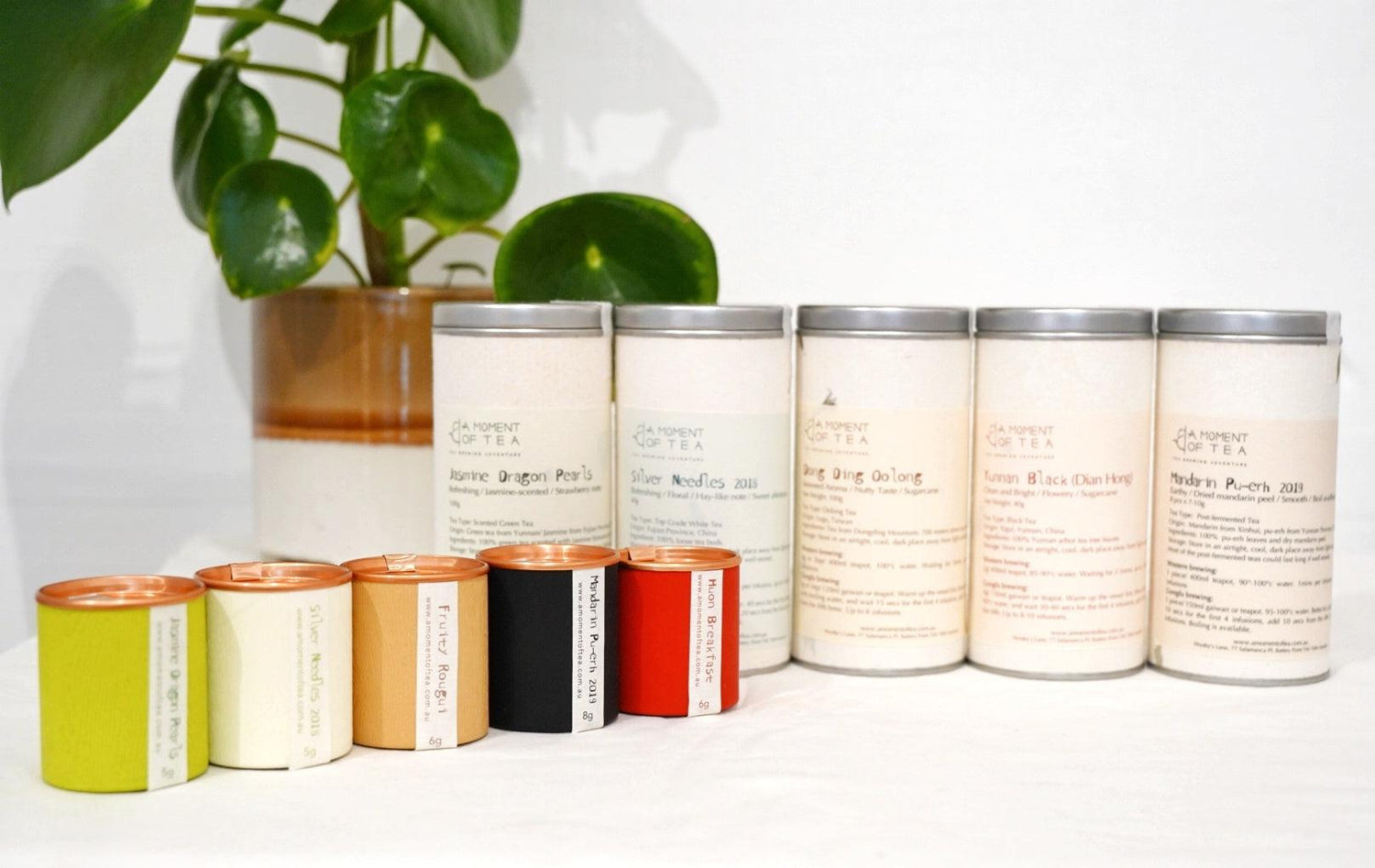


What is pu-erh tea? A beginner's guide from a Hobart tea shop
Pu-erh tea is a fermented Chinese tea from Yunnan province, traditionally aged or post-fermented before drinking. It comes in two main styles, raw (sheng) and ripe (shou), and you'll find it sold loose, pressed into bricks or cakes, or rolled into small balls. If you've heard the name but never tried it, this is the guide for you.
We're A Moment of Tea, a small Chinese tea shop in Salamanca, Hobart. More people coming to the Tea Bar these days are curious about pu-erh, and most of them mean ripe pu-erh. This page is the longer version of the conversation we'd have over a small cup at the counter.
"This tea is a hug in a cup. A tea for the soul. No matter how long you steep it for, it does not go bitter."
Laura R., on Tasmanian Lavender Pu-erh
What is pu-erh tea?
Pu-erh comes from large-leaf tea trees in Yunnan, in the southwest of China. The leaves are picked, withered, fixed in a hot pan, rolled, and dried into a base material called maocha. From there, pu-erh follows one of two paths: a long, slow natural ageing, or a controlled wet-pile fermentation called wodui. That choice is what splits pu-erh into raw and ripe.
The word "post-fermented" gets used a lot in pu-erh writing. It just means the tea keeps changing in the bag, the brick, or the cake, long after it's been processed. A pu-erh you buy this year will taste different in five years. That's part of what makes it interesting.
Pu-erh sits in the dark tea family, one of the six types of Chinese tea. The naming can feel confusing (dark tea, black tea, red tea), because the English and Chinese categories don't line up neatly. We explain why those names don't match in our red tea guide.
Raw vs ripe: the first fork in the road
Almost every pu-erh question eventually lands here: raw or ripe?
Raw pu-erh (sheng) is the older style. It's pressed or kept loose and left to age slowly over years or decades. When young, it's bright, brisk, sometimes a little astringent, with grassy or fruity notes. Aged raw pu-erh softens and deepens, picking up dried fruit, honey, or wood. Many people who love raw pu-erh enjoy that long arc: the same tea tasting different five years later.
Ripe pu-erh (shou) is the newer style. The wodui technique was developed in 1973 at Kunming Tea Factory to speed up that ageing process. Leaves are piled, dampened, and turned for weeks to a few months. The result is a tea that drinks ready right away. The liquor pours a deep amber-brown, the colour the Chinese call zhū gān hóng, "pig-liver red." The flavour is smooth, earthy, often with notes of cooked rice, wood, or cocoa.
If you've never had pu-erh before, ripe is usually the easier place to start. It's softer, sweeter, less green. Raw rewards a bit of patience and curiosity.
For a deeper read on the differences, see our full pu-erh guide: understanding raw vs ripe.
What pu-erh actually tastes like
Tasting notes get long. Here are the four words that come up most often when people describe pu-erh at our Tea Bar:
- Earthy. Like forest floor after rain, damp wood, mushroom. This is the most common note in ripe pu-erh.
- Glutinous rice. A sweet, comforting aroma similar to sticky rice cooking. Some Yunnan ripe pu-erhs are famous for it.
- Smooth. A body that coats the mouth without being heavy. Aged tea often gets called this.
- Aged wood or dried fruit. More common in older raw pu-erh.
Customers tend to describe it in their own way. Two we keep hearing:
"I tried the Tasmanian Lavender Pu-erh, which was delicious with its biscuit and lotus undertones."
Ziyad A., tasted in-store at our Tea Bar
"The calming lavender and earthy puerh feels very 'Tasmanian'. I'm looking forward to trying more teas here."
Sam H., on his first cup of pu-erh
If you're new, don't worry about catching every note. Start with a simple question: does the tea feel comforting, or jarring? Comfort is usually the first sign that a particular pu-erh suits you.
Pu-erh and how it sits in the body
A few words on health, with the caveat that we're tea makers and not doctors.
In southern China, ripe pu-erh is often served after rich meals. We talk about it as an after-meal tea habit, not as a medical effect. Customers at the Tea Bar tell us they reach for ripe pu-erh after a long lunch or a heavy dinner, and that habit has cultural roots going back centuries. For the science side, tea research more broadly points to polyphenols and antioxidants as the active compounds across all true tea, and we cover that comparison in our antioxidants in tea guide.
Pu-erh contains caffeine. The amount depends on the leaf, the age, and how you brew it. As a rough rule, ripe pu-erh sits lighter than a strong black tea and ranges from low caffeine (in blended Tasmanian Lavender Puerh and certain pure ripes like Sweet Stock) to medium caffeine (in more bodied ripes like Ripe Pu-erh 2021, "The One" cake, and Mandarin Pu-erh). For a full breakdown, see our tea and caffeine guide.
"The Puerh has a lovely earthy flavor that's not too overpowering. I love how the Puerh keeps me alert while the lavender brings a calming effect."
Andrew H., on Tasmanian Lavender Pu-erh
We don't treat pu-erh as medicine. People drink it because it's good. That's enough.
Three ways to brew pu-erh
There's no single right way. Pick the one that fits your kitchen.
Western style is the easy default. Around 3–4g of tea per 250ml mug, water at 95–100°C, two to three minutes of steeping. Re-steep two or three times; pu-erh forgives a long steep better than most teas.
Gongfu style is the Chinese small-pot method. Around 5–7g of leaf in a small gaiwan or clay pot (about 100ml), water at 95–100°C, very short infusions starting at 10–20 seconds and growing slightly each round. You can pull 8 to 12 infusions out of a good pu-erh this way. The first cup of each round is a small sip, so you taste how the leaf changes.
Boiled (or simmered) is traditional in Yunnan, especially for older ripe pu-erh. A small handful of leaf goes into a kettle of just-off-the-boil water, simmered gently for a few minutes. It pours thick and warming. Good for cold afternoons in Hobart.
We include detailed parameters on the back of every product page and on the brewing card inside our sampler packs. The general rule: more leaf, hotter water, shorter time; pu-erh likes intensity.
Where to start drinking pu-erh
The honest answer depends on what kind of starting point you want.
If you're brand new to pu-erh. The lowest-risk way in is our Pu-erh Starter Pack: five 5g samples that follow Joanne's ripe pu-erh progression. Two blended entries (Tasmanian Lavender and Mandarin), a simple pure ripe (the "Sweet Stock" huang pian — Joanne's daily drinker), a more layered spring-picked loose leaf (Ripe Pu-erh 2021), and a compressed cake that includes ancient-tree leaves ("The One"). All ripe (shou), all from the same shop, all with a brewing card. About thirty-five grams of leaf, enough for ten to twenty cups depending on how you brew. After the pack, you'll know where on the progression your palate wants to live. Try the Pu-erh Starter Pack.
If you already love Tasmanian Lavender Pu-erh. The closest pure cousin in our range is our Ripe Pu-erh 2021. Same Menghai ripe-pu-erh direction, without the lavender. If you've always wondered what the underlying tea tastes like on its own, this is it. Smooth, sweet, faintly rice-like, no floral. A natural next step that doesn't ask you to leave familiar ground.
If you want a no-fuss daily ripe pu-erh. Skip the blended teas and start with our "Sweet Stock" Ripe Pu-erh Brick 2021. It's huang pian, mature leaves from sixty-plus year old trees in Xigui, pressed into a 258g brick. Joanne keeps it at home as her daily pu-erh, often brewed in a thermos through the afternoon. At $79 the brick works out reasonably per cup, and the flavour is exactly what the name suggests: sweet, leafy, steady. The most affordable way to live with pure ripe pu-erh as a daily habit.
Quick guide: what to buy first
If you'd rather not read all of the above, here's the same advice as a five-row table.
| If you say... | We'd suggest |
|---|---|
| "I've never had pu-erh before." | Pu-erh Starter Pack, five 5g samples |
| "I already love Lavender Pu-erh." | Ripe Pu-erh 2021, its pure cousin |
| "I want a simple, no-fuss daily ripe pu-erh." | "Sweet Stock" Ripe Pu-erh Brick 258g, Joanne's home daily — good in a flask |
| "I want a Tasmanian gift." | Tasmanian Lavender Puerh 60g, awarded at the 2025 Royal Tasmanian Fine Food Awards |
| "I want depth, tea energy, and a tea worth aging." | "The One" Ripe Pu-erh Cake 2024, 200g, around 50 gongfu sessions |
You can also browse the full pu-erh tea collection if you'd rather start from the catalogue.
Frequently asked questions
Does pu-erh tea have caffeine? Yes. Pu-erh is a true tea from Camellia sinensis, so it contains caffeine. Ripe pu-erh ranges from low caffeine (in blended Tasmanian Lavender Puerh and pure ripes like Sweet Stock huang pian) to medium caffeine (in more bodied ripes like Ripe Pu-erh 2021, "The One" cake, and Mandarin Pu-erh). Raw pu-erh tends to be higher in caffeine.
Can I drink pu-erh tea every day? Many people do. Pu-erh has been part of daily life in Yunnan and Hong Kong for generations. As with any caffeinated tea, listen to your body and avoid drinking it on an empty stomach if you're sensitive.
Is pu-erh safe during pregnancy? Pu-erh contains caffeine and tannins, like all true tea. Most guidance suggests keeping total caffeine intake low during pregnancy. If you're unsure, ask your doctor or midwife. Herbal blends and pure raw pu-erh follow the same general advice.
How do I store pu-erh tea? Keep it cool, dry, and away from strong smells. Pu-erh is one of the few teas that ages well in normal conditions — a cupboard is fine. Don't keep it in the fridge. If you've bought a cake or a brick, leave it whole until you're ready to drink it.
Does pu-erh tea expire? Most pu-erh has no real expiry. Properly stored, raw pu-erh can age for decades and improve over time. Ripe pu-erh is usually drunk within the first ten years, though it keeps well beyond that. Blended pu-erhs that contain other ingredients (lavender, chen pi) follow the shelf life of the additions — best within two to three years.
What does "vintage year" mean for pu-erh? Pu-erh is dated by harvest year because the tea continues to change as it ages. A 2021 ripe pu-erh and a 2024 ripe pu-erh from the same factory will taste slightly different even on the same shelf. The year tells you roughly where the tea is in its arc.
Is pu-erh tea available in Australia? Yes. We're based in Hobart, Tasmania, and ship pu-erh across Australia. You can order from the pu-erh tea collection online, or visit the Tea Bar at Salamanca Art Centre, 77 Salamanca Place.
Next reads
- Pu-erh tea guide: understanding raw vs ripe. The long version of the sheng/shou split.
- Tasmanian Lavender Pu-erh: our Silver Medal blend. The story behind the blend, and our experience at the Royal Tasmanian Fine Food Awards.
- Xinhui chen pi: aged mandarin peel. For readers curious about the Mandarin Pu-erh half of our range.