
Loose Leaf Tea FAQ
We get asked these questions a lot at our Tea Bar in Salamanca and at the Saturday market. Here are the honest answers — no fluff, just what we've learned from years of working with tea.
Getting started with loose leaf tea
What is loose leaf tea and why is it different from tea bags?
Loose leaf tea is whole or large pieces of tea leaves, sold without being packed into bags. The difference matters because tea bags typically contain fannings and dust — the smallest broken bits left over from processing. Those tiny particles release tannins quickly, which is why bagged tea often tastes bitter or one-dimensional.
Whole leaves have more surface area locked inside, so they unfurl gradually in hot water and release flavour in layers. You'll notice a smoother body and more complex taste. Loose leaf also keeps much longer — properly stored, most teas hold their quality for 12 to 24 months, while tea bags tend to go stale within a few months of opening. The per-cup cost ends up similar because you can steep good loose leaf multiple times.
What are the main types of Chinese tea?
Chinese tea is traditionally grouped into six categories based on how the leaves are processed, not the plant — they all come from the same species, Camellia sinensis.
The six types are: green tea (unoxidised, fresh and grassy), white tea (minimally processed, soft and delicate), yellow tea (rare, gently oxidised), oolong tea (partially oxidised, ranging from floral to roasted), black tea (fully oxidised, bold and malty), and dark tea / puerh (post-fermented, earthy and smooth). At A Moment of Tea we carry all six types. If you're just starting out, green and oolong are approachable entry points.
How do I choose my first loose leaf tea?
Start from what you already enjoy. If you drink English Breakfast or Earl Grey, try a Chinese black tea like Lapsang Souchong or Keemun — they're in the same family but with more character. If you prefer lighter flavours, a Jasmine Dragon Pearl is a reliable first step because the jasmine scent makes it approachable.
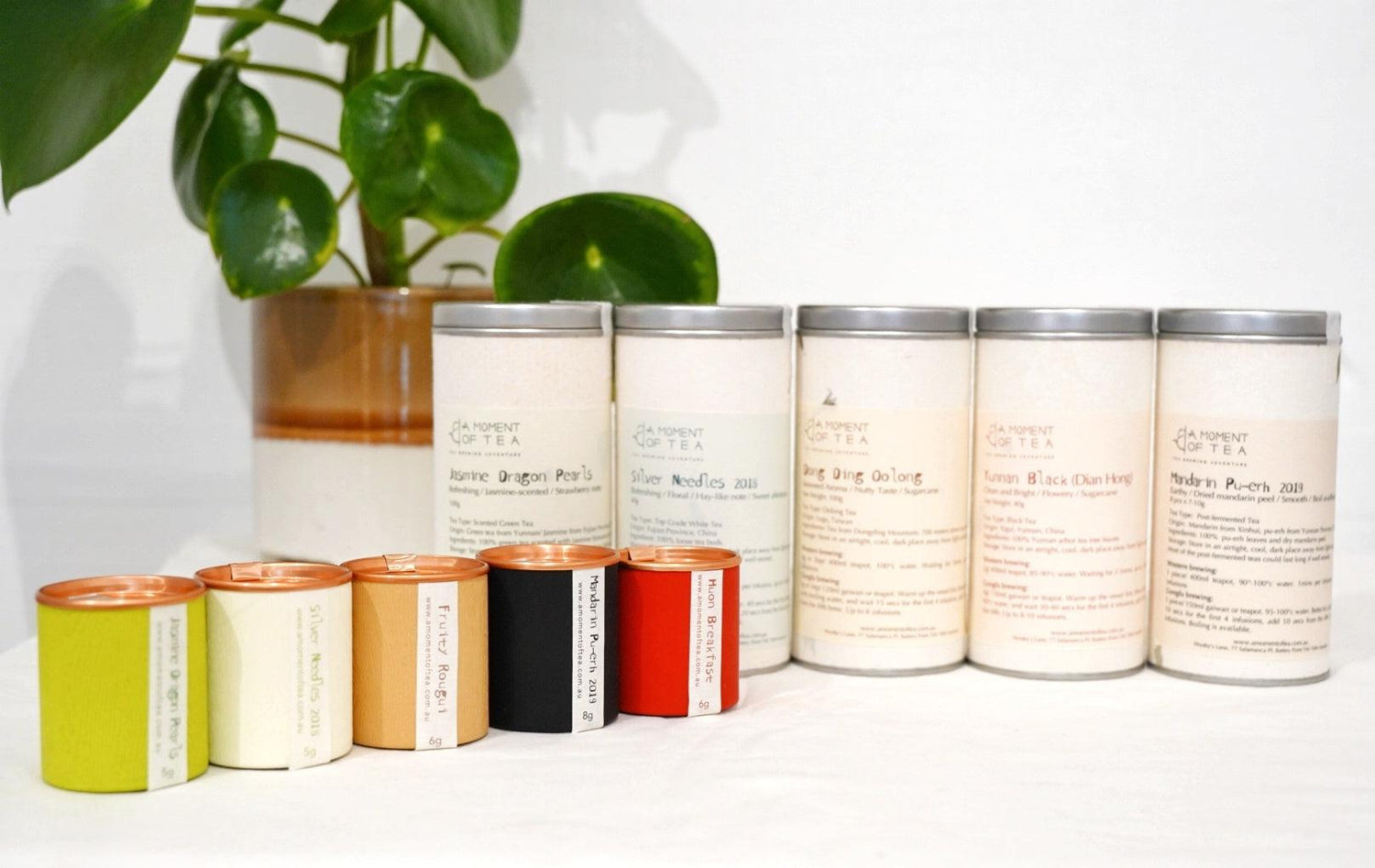
We also put together sampler packs sorted by time of day — morning, afternoon, and evening — so you can try four or five teas without committing to a full packet. That's how most of our regulars found their favourites.
Is loose leaf tea worth the extra cost?
On a per-cup basis, loose leaf often works out cheaper than specialty tea bags. A 50-gram packet of quality Chinese green tea makes around 25 to 30 cups at standard Western brewing. With Gongfu-style brewing using smaller vessels, you'll get even more from the same leaves because each steep pulls different flavour notes.
Beyond the maths: the taste difference is noticeable from the first cup. Tea bags are convenient, and there's nothing wrong with them for quick brews. But if you're someone who actually tastes your tea rather than just drinking it, whole leaf gives you a lot more to work with. It's a bit like ground coffee versus fresh beans — same plant, different experience.
What are the health benefits of Chinese tea?
Tea leaves naturally contain antioxidants (particularly catechins in green tea and theaflavins in black tea), L-theanine (an amino acid linked to calm focus), and modest amounts of caffeine. Green and white teas tend to retain more catechins because they're less processed. Puerh has been studied for its effect on lipid metabolism, though research is still evolving.
It's worth being careful about big health claims — tea is a drink, not medicine. That said, building a tea habit tends to slow people down a bit during the day, and that pause itself seems to help. If you're sensitive to caffeine, herbal tisanes and caffeine-free blends are a good option for evenings.
Brewing your tea
How do I brew green tea without making it bitter?
Bitterness in green tea almost always comes from water that's too hot or steeping too long. Green tea leaves are delicate — boiling water (100°C) scorches them and forces out harsh tannins fast.
Use water between 70–80°C. If you don't have a temperature-controlled kettle, boil the water and then let it sit for about 3 minutes, or pour it into a room-temperature cup first to bring the temperature down. Steep for 2 to 3 minutes maximum on the first brew. A Dragon Well or Mengding Sweet Dew brewed at the right temperature will taste sweet and clean with no bitterness at all.
What water temperature should I use for different teas?
Here's a practical guide:
Green tea: 70–80°C. White tea: 80–85°C. Oolong tea: 90–95°C for roasted styles, 85–90°C for lighter oolongs. Black tea: 95–100°C. Puerh tea: 95–100°C (boiling is fine). Herbal / flower tea: 90–100°C.
The general rule: lighter teas need cooler water, darker teas can handle hotter water. If you're not sure, err on the slightly cooler side — you can always steep a bit longer, but you can't un-scald the leaves. A variable-temperature kettle takes the guesswork out, though it's not essential when you're starting out.
How much tea should I use per cup?
For Western-style brewing in a mug or teapot (200–300ml), use about 2 to 3 grams of tea — roughly a teaspoon for most teas, though bulky leaves like white tea or oolong need a bigger pinch by volume.
For Gongfu-style brewing in a small vessel (100–150ml), the ratio jumps to 5 to 8 grams because you're using more leaf, less water, and shorter steep times. This gives a more concentrated, layered flavour across multiple infusions. Most quality loose leaf teas come with a suggested brewing ratio on the packet, so you'll have a starting point. From there, adjust to your own taste — more leaf for stronger, less for lighter.
Can I reuse tea leaves? How many times?
Yes — re-steeping is actually one of the best things about quality loose leaf. Most of the teas we sell are good for at least 3 to 5 steeps, and some go much further. Oolong and puerh are particularly rewarding to re-steep because the flavour shifts noticeably with each infusion — the first steep might be floral, the second more creamy, the third more mineral.
High-quality puerh can handle 8 to 12 steeps easily. Our Raw Puerh Ancient Single Tree is a good example — it evolves right through the session. Add about 15 to 30 seconds to each subsequent steep to compensate as the leaves gradually give up their flavour.
What's the best way to store loose leaf tea?
Tea has four enemies: light, moisture, air, and strong odours. Keep your tea in an airtight, opaque container — a tin or ceramic caddy works well. Avoid clear glass jars on the bench, even though they look nice. Store in a cool, dry spot away from the stove and spice rack.
Most green, white, and oolong teas are best consumed within 12 months of purchase. Black tea holds a bit longer. The exception is aged teas — puerh and certain aged white teas actually improve over time when stored correctly, similar to wine. For those, keep them in a breathable container (not fully sealed) in a stable-temperature environment. Avoid the fridge — the humidity and food odours are bad news for tea.
Going deeper with tea
What is Gongfu tea brewing?
Gongfu (功夫茶) translates roughly to "making tea with skill." It's a Chinese brewing method that uses a higher leaf-to-water ratio in a small vessel — typically a gaiwan or small Yixing clay teapot (100–150ml) — with short steeping times starting around 10 to 20 seconds.
The point isn't ceremony for ceremony's sake. Using more leaf and less water lets you pull out the flavour in stages, so each steep tastes a bit different. You might get seven or eight very different cups from one session. It works especially well with oolong, puerh, and black teas. It does take a little practice, but the basics are straightforward once you've done it a few times.
What is the difference between raw and ripe puerh?
Both start as sun-dried tea from Yunnan province, but their processing paths split from there.
Raw puerh (sheng) is compressed and left to age naturally. Young raw puerh can be bright, astringent, even sharp. Over years and decades, it mellows into something complex and smooth. Our Raw Puerh Ancient Single Tree is a good example of the aged style.
Ripe puerh (shou) was invented in the 1970s as a shortcut — the leaves go through an accelerated fermentation process called wo dui that mimics decades of natural ageing in a matter of weeks. The result is dark, smooth, and earthy from day one. Our Tasmanian Lavender Puerh uses a ripe puerh base.
How do I season a new Yixing teapot?
Yixing clay is porous, so seasoning opens the pores and removes any residual clay dust from production. Here's the process we recommend:
Rinse the teapot thoroughly in warm water. Place it in a large pot of water (use a cloth underneath to prevent chipping), bring to a gentle boil, and simmer for 30 to 60 minutes. While it's simmering, brew a strong batch of the tea type you plan to use in this teapot. After boiling, let the teapot cool, then submerge it in that brewed tea for 24 hours. Rinse with warm water and air dry completely.
One important rule: dedicate each Yixing teapot to one tea type. The clay absorbs flavour over time, which is the whole point — a well-used Yixing pot eventually contributes to the brew.
What teaware do I need as a beginner?
You don't need much. A gaiwan (lidded bowl) is the most versatile single piece of teaware you can buy. It works for every tea type, it's easy to clean, and it teaches you to control your brew. A basic ceramic gaiwan costs around $20 to $40.
Beyond that, a fairness cup (cha hai) to pour into and a couple of small cups is all you need for a proper Gongfu session. If you prefer Western-style brewing, a glass teapot with infuser lets you watch the leaves unfurl, which is genuinely enjoyable. Skip the expensive sets until you know what style of brewing suits you.
How do I know if my tea is good quality?
Look at the dry leaves first. Good tea should be uniform in size and shape — broken, dusty leaves are a sign of lower grades. The colour should be consistent, and the leaves should have a distinct, clean aroma even before brewing.
When brewed, quality tea produces a clear liquor (cloudiness often means poor processing). The taste should be clean, with no harsh chemical or musty off-flavours. Good green tea should not taste bitter at the right temperature. Good puerh shouldn't taste muddy.
The strongest indicator is re-steepability. If your tea tastes flat after one steep, the leaves probably weren't great to begin with. Quality loose leaf holds up across multiple infusions, with the flavour evolving rather than just fading.
Visiting us in Hobart
Where can I buy authentic Chinese tea in Hobart?
A Moment of Tea is a dedicated Chinese tea shop in Hobart, located inside Salamanca Art Centre at Woobys Lane, 77 Salamanca Place, Battery Point, TAS 7004. We carry over 100 varieties of loose leaf tea sourced directly from China, Japan, and Tasmania.
Our Tea Bar is open Tuesday to Sunday (closed Mondays). You can try teas before buying, and we'll walk you through the options based on what you're looking for. On Saturdays, you'll also find us at Salamanca Market with a curated selection of our most popular teas. Everything available in-store is also on our online shop with delivery across Australia.
Does A Moment of Tea offer tea tasting experiences?
Yes. Our Tea Bar at Salamanca Art Centre (Woobys Lane, 77 Salamanca Place, Battery Point) is set up specifically for tea tasting. You can drop in any time we're open — Tuesday to Sunday — and sample teas at the bar. There's no charge for a quick taste to help you decide what to buy.
We've also run tea workshops and guided Gongfu tea sessions for small groups. Those are taking a break for 2026, so we're not taking workshop bookings at the moment. In the meantime, Joanne, our founder and tea specialist, is usually at the bar and happy to talk you through brewing while you taste. You can read about what the workshops involve on our workshops page.
What is special about Tasmanian Lavender Puerh?
Tasmanian Lavender Puerh is a blend we created in-house using Menghai ripe pu-erh from Yunnan and dried lavender grown in Tasmania. It received a Silver Medal, with the highest score in its category, at the 2025 Royal Tasmanian Fine Food Awards.
The idea came from wanting to bridge Chinese tea tradition with Tasmanian local produce. The puerh base is earthy and smooth, and the Tasmanian lavender adds a floral note without overpowering the tea character. It brews well both hot and as a cold brew. It comes in a small tasting size as well as larger bags and cans. It's become one of our most popular teas, especially with visitors to Hobart who want something they can only get here.
Can I learn tea ceremony in Tasmania?
A Moment of Tea has run Gongfu tea ceremony workshops at our Tea Bar in Salamanca Art Centre, Woobys Lane, 77 Salamanca Place, Battery Point, Hobart. Sessions cover the fundamentals of Chinese tea preparation — choosing the right teaware, controlling water temperature, pouring techniques, and how to appreciate the tea through multiple steeps.
Joanne Gao, our founder, trained at China's Lian Yu Tea School and has over 10 years of tea ceremony experience. The workshops are on a break for 2026, so there are no dates to book right now. If you'd like to hear when they return, send us a note through the contact page with "workshops" in the message. Until then, the best way to learn is to sit at the Tea Bar and watch a few steeps being brewed in front of you.
Does A Moment of Tea have a physical store?
Yes. Our Tea Bar is at Woobys Lane, 77 Salamanca Place, inside Salamanca Art Centre, Battery Point, TAS 7004. It's a short walk from Hobart's waterfront, right in the Salamanca precinct.
We're open Tuesday to Sunday (closed Mondays). The space is set up as a working tea bar where you can sit down, try different teas, and learn about what you're drinking. It's not a cafe in the traditional sense — the focus is on the tea itself, brewed properly in front of you. On Saturdays, we also have a stall at Salamanca Market. If you can't visit in person, our full range ships Australia-wide from amomentoftea.com.au.
More Blog About us
View all-

Joanne's Newest ABC Radio Interview in 2023
Joanne's 2023 ABC Tasmania Afternoons interview about her tea journey, the six Chinese tea types and why oolong can be a useful starting point.
1 commentJoanne's Newest ABC Radio Interview in 2023
Joanne's 2023 ABC Tasmania Afternoons interview about her tea journey, the six Chinese tea types and why oolong can be a useful starting point.
1 comment -

Joanne's ABC Radio Interview in 2022 : A Journe...
Joanne reflects on her 2022 ABC Radio interview about seasonal tea, her tea journey from Beijing, Guqin music and finding quiet through brewing.
Joanne's ABC Radio Interview in 2022 : A Journe...
Joanne reflects on her 2022 ABC Radio interview about seasonal tea, her tea journey from Beijing, Guqin music and finding quiet through brewing.
-
My Feature on ABC News in 2020
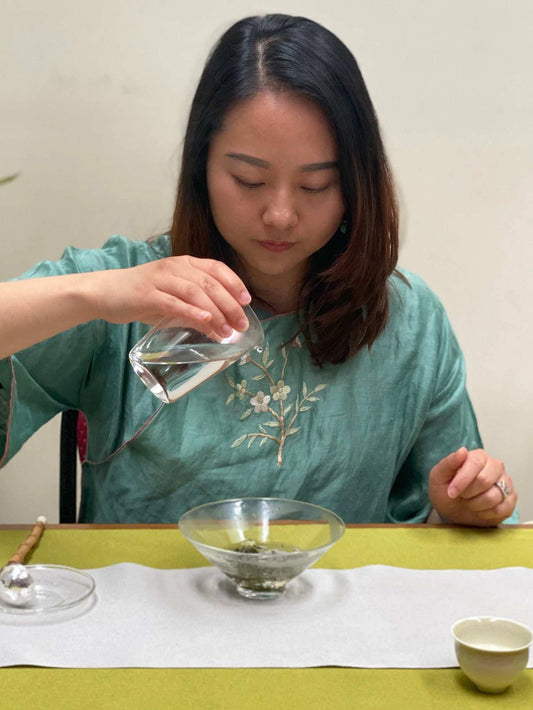
Joanne shares her 2020 ABC News feature on A Moment of Tea, cultural connection and the Moonah Bazaar project in Tasmania.
My Feature on ABC News in 2020
Joanne shares her 2020 ABC News feature on A Moment of Tea, cultural connection and the Moonah Bazaar project in Tasmania.
