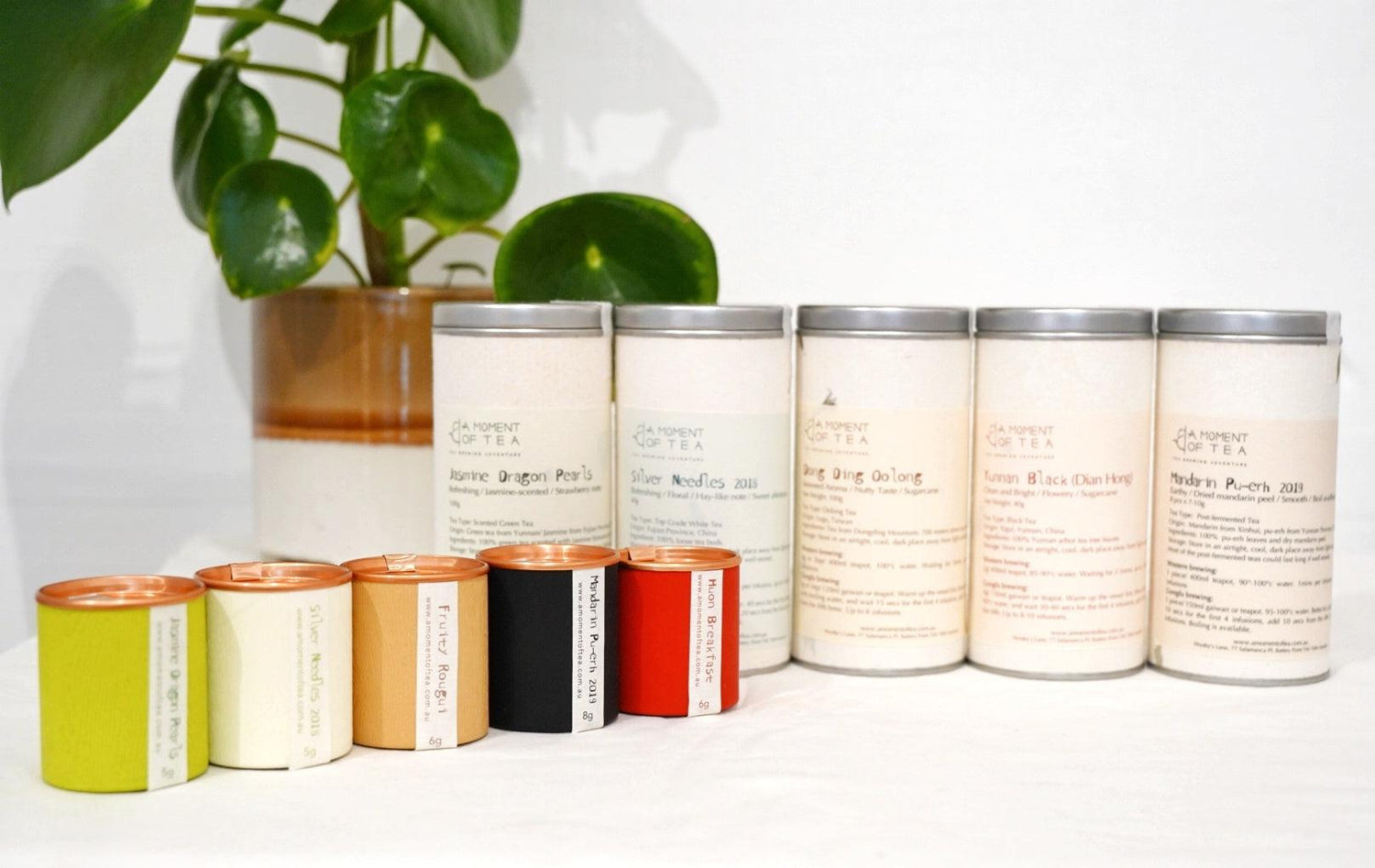

Understanding tea quality: what makes a tea "good"?
Good tea is tea that tastes clean, smells true to its type, and leaves a pleasant sensation in your mouth and throat after you swallow. There is no single standard for "good" across all tea types, but there are reliable signs your body can pick up on: a smooth texture, a lingering sweetness at the back of your throat called huigan (回甘, huígān), and flavours that develop across multiple infusions rather than fading after the first cup.
A few weeks ago, a customer walked into our Tea Bar at Salamanca Art Centre holding a small tin. "I bought some loose leaf tea from a supermarket," she said. "It tasted like the tea bags I used to drink, just without the bag. What am I missing?" That conversation happens more often than you might think. And the honest answer is: the gap between a tea bag and a carefully sourced loose leaf tea is wide, but the gap between an average loose leaf tea and a good one can be just as wide.
This article is a decision tree. It walks you through three levels of tea quality evaluation so you can judge for yourself what belongs in your cup.

Level 1: from tea bags to loose leaf
Most people start with tea bags. There is nothing wrong with that. But understanding what is inside a tea bag helps explain why loose leaf tea tastes different.
A standard tea bag contains about 1.5 to 2 grams of tea dust and fannings. These are the smallest particles left over after tea processing. Because the leaf cells are already broken, the tea releases everything it has in one steep. You get a strong, consistent cup, but the flavour is one-dimensional. There is no second or third infusion waiting to reveal something new.
Loose leaf tea uses whole or large pieces of leaf. The cell structure is mostly intact, which means flavour compounds release gradually across multiple steeps. A good oolong (乌龙茶, wūlóng chá) might give you six or seven infusions, each one tasting slightly different from the last. That progression is one of the clearest markers of leaf quality.
Here is a simple first test you can do at home:
- Look at the dry leaf: Can you see whole leaves or recognisable leaf pieces? Broken dust and uniform powder suggest heavy machine processing.
- Smell the dry leaf: It should smell clean and distinct. Stale tea smells flat or papery.
- Brew it twice: If the second infusion tastes thin and empty, the leaf did not have much to give. If the second cup is still flavourful, the leaf quality is higher.

This two-brew test is something I suggest to everyone who visits the Tea Bar for the first time. It costs nothing, takes five minutes, and it trains your palate faster than reading any guide.
Level 2: why the same tea name can mean very different things
Once you have moved into loose leaf tea, a new question appears: why does the same tea, sold under the same name, vary so much in price and taste?
We had a customer email us after buying our Yunnan Black Tea (Dian Hong). He had found another store selling "Dian Hong" (滇红, diānhóng) for around $10 AUD, and ours was priced higher. He wanted to know what justified the difference.
The answer comes down to three things:
1. Source material
Our Dian Hong comes from Yunnan province. But "Yunnan black tea" is a broad category. Tea from ancient trees (古树茶, gǔ shù chá) that are over 100 years old produces leaves with deeper root systems and more complex flavour compounds than tea from young plantation bushes. The ancient tree version has a thicker mouthfeel, a longer-lasting sweetness in the throat, and often a noticeable body warmth after drinking. The plantation version can taste fine, but the depth is not there.
2. Processing care
Tea processing is where craft meets chemistry. For black tea (红茶, hóngchá), the degree of withering, the pressure during rolling, and the temperature during the oxidation phase all shape the final cup. Factory-scale production prioritises consistency and speed. Small-batch production allows the tea maker to adjust each step based on the specific leaves that day. Both approaches produce "Dian Hong," but the resulting cup can be very different.
3. Storage and handling
Tea absorbs moisture and odours. Poorly stored tea loses its character within months. I have seen teas that were exceptional at origin arrive in Australia tasting flat because the storage chain was not well managed.

Price alone does not guarantee quality. But when a tea costs significantly less than others with the same name, it is worth asking what was cut: the age of the trees, the care in processing, or the attention to storage.
Level 3: trust your body
This is the part that matters most, and it requires no expertise at all.
Joanne hosted a community pu-erh (普洱茶, pǔ'ěr chá) tasting at our Tea Bar. One of the guests brought a pu-erh cake they had picked up from an Asian supermarket. We brewed it alongside one of ours using the same water, temperature, and timing. The difference was immediate. The supermarket pu-erh had a fishy, musty smell that sat heavy in the cup. Ours was earthy and smooth, with a clean finish. Nobody in the room needed a certificate to tell which one they preferred. Their noses and tongues did the work.
Your body is a reliable instrument for judging tea. Here is what to pay attention to:
- Smell: Good tea smells clean and inviting before and after brewing. Off-putting odours (fishy, chemical, excessively smoky when it should not be) are warning signs of poor storage or processing shortcuts.
- Mouthfeel: Quality tea has texture. It might feel silky, thick, or coating. Low-quality tea often feels thin and watery regardless of how much leaf you use.
- Aftertaste (回甘, huígān): After swallowing, notice your throat and the back of your tongue. Good tea leaves a returning sweetness there. Some teas also produce salivation (生津, shēngjīn), a sensation of your mouth naturally producing moisture. These are signs that the tea has substance.
- Body response: Some teas, particularly aged pu-erh and teas from old trees, produce a gentle warming sensation through the body. In Chinese tea culture this is called tea energy (茶气, cháqì). You may not notice it every time, but when you do, it is a strong indicator of leaf quality.
One of our customers, Angus, described trying our aged mandarin peel tea for the first time: "I expected fresh mandarin but instead was surprised by waves of complexity — love at first sip." That moment of surprise, when a tea delivers something richer than what you expected, is a sign you are drinking something with real depth.

There is one more test that professionals use: examining the spent leaves (叶底, yèdǐ). After brewing, tip the leaves out and look at them. Whole, flexible leaves with even colour suggest careful picking and processing. Leaves that are dark, brittle, or heavily broken tell a different story.
Tips from our Tea Bar
When customers ask me how to start choosing better tea, I usually say: forget about price first. Taste two teas side by side. One you already know, one that is new. Your palate will tell you more in five minutes than a week of reading about tea grades and certifications. If you want a method to follow while you taste, our guide to how to taste tea walks through it step by step.
If you are moving from tea bags to loose leaf for the first time, a sampler pack is a low-risk way to try several types without committing to a full bag. We have morning, afternoon, and evening sampler packs that cover different tea categories.
For anyone who wants to go deeper, visit a tea shop where you can smell and taste before buying. At our Tea Bar in Salamanca Art Centre, Hobart, you can try any tea we carry. There is no pressure. Sometimes the best tea for you is the one that simply makes you want a second cup.
Frequently asked questions
Is expensive tea always better than cheap tea?
Not always. Price reflects factors like rarity, origin, and labour cost, which do not automatically translate to a taste you prefer. A $15 loose leaf Dian Hong might suit your palate better than a $50 aged pu-erh. The best approach is to taste at your price range and notice which teas give you the clearest aftertaste and the most infusions.
How can I tell if loose leaf tea has gone stale?
Smell the dry leaf. Fresh tea has a distinct aroma matching its type: green tea smells vegetal or nutty, oolong smells floral or roasted, black tea smells malty or sweet. Stale tea smells flat, papery, or like cardboard. If there is no aroma at all, the tea has lost most of its character.
Does the colour of brewed tea indicate quality?
Colour indicates the type and processing of the tea, not quality directly. A pale white tea and a dark pu-erh can both be excellent. What does indicate quality is clarity: the brew should be clear and bright for its type, not cloudy or muddy. Cloudiness can suggest poor processing or stale leaves.
How many times should I be able to re-steep good loose leaf tea?
It depends on the type. Green tea typically gives 2 to 3 good steeps. Oolong can go 5 to 8 steeps. Pu-erh and some white teas can handle 10 or more. If a tea marketed as high-quality fades completely after one steep, the leaf quality may not match the label.
What is the quickest way to improve my ability to judge tea?
Taste two teas side by side using the same water and brewing method. Comparison sharpens your palate faster than tasting one tea at a time. Pay attention to what happens after you swallow, not just the first sip.
Teas mentioned in this article
- Yunnan Black Tea (Dian Hong)
- Raw Pu-erh Ancient Single Tree
- Tasmanian Lavender Pu-erh — awarded a Silver Medal at the 2025 Royal Tasmanian Fine Food Awards
- Morning Teas Sampler Pack
- Afternoon Break Teas Sampler Pack
- Evening Tea Sampler Pack
Published: March 2026 | Last updated: July 2026